
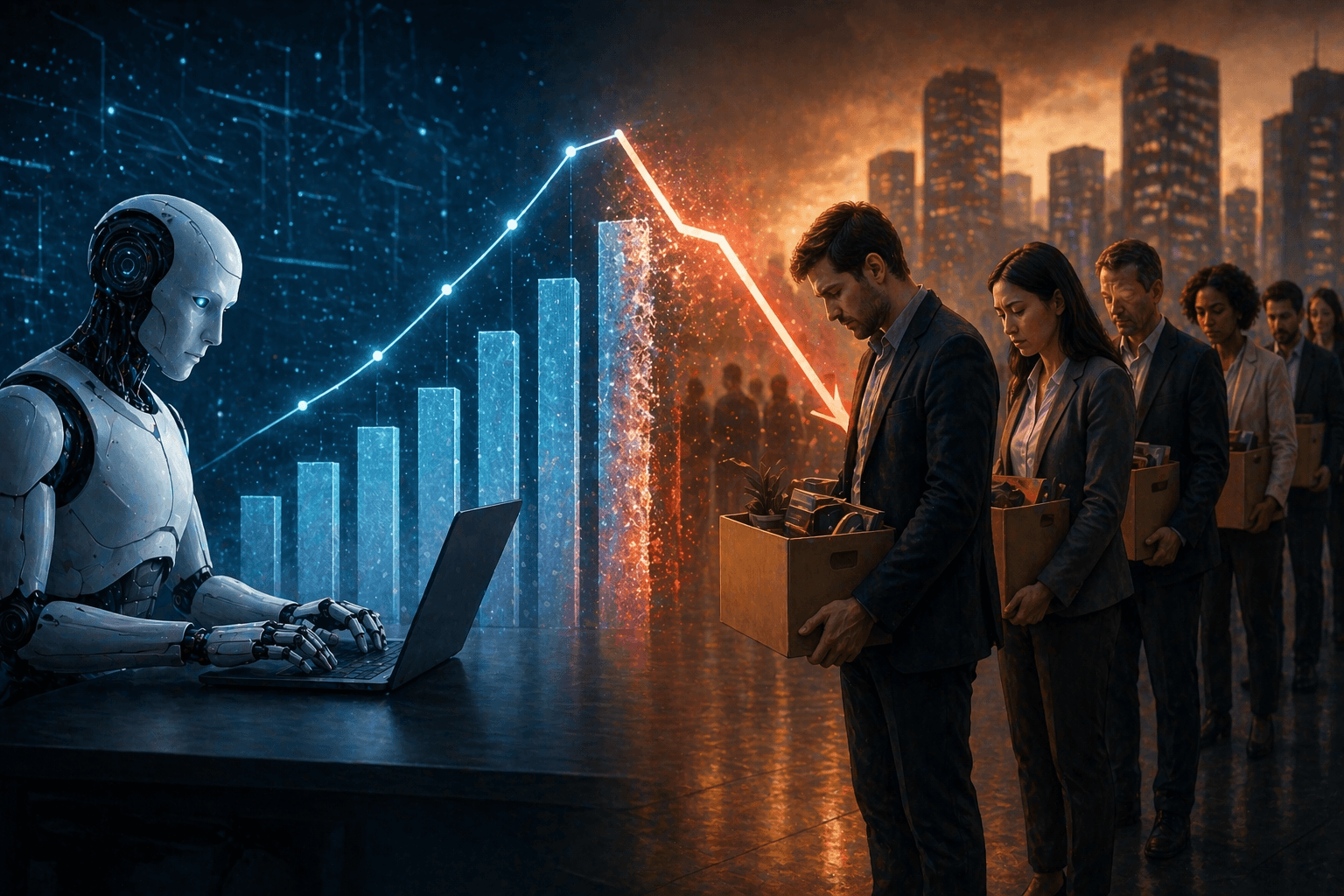
Study: AI Is Compressing Pay and Accelerating Job Displacement Across Corporate America — 3,000 Managers Weigh In
AI / AI Tech Trends | 3 min read
Beautiful.ai (San Francisco; the AI-powered presentation software combining smart templates, automation, and AI-assisted workflows for businesses from small teams to global enterprises), has released its third annual "AI's Impact on the Workplace" report — based on a Pollfish survey of 3,000 US managers conducted 14–16 February 2026. Now in its third year, the report tracks how AI is progressively reshaping compensation, workforce structure, and professional expectations. The central finding: AI is no longer experimental. It is actively repricing work, compressing wages, and accelerating workforce recalibration — while productivity rises and anxiety grows alongside it.
Five Key Findings — Pay, Displacement, Capability, Anxiety, and the Path Forward
Compensation is under pressure. AI-driven productivity is beginning to reprice work at scale. 45% of managers believe AI will push salaries down — and 55% say it could reduce their own pay. This is not a concern confined to frontline workers. The anxiety is moving up the organisational chart into management itself. Job displacement is gaining acceptance. Only 9% of managers say reducing headcount is the primary reason for adopting AI — yet confidence in AI's capabilities is accelerating the workforce recalibration regardless of stated intent. The result is displacement without explicit displacement mandates. AI output is matching experienced managers. 58% of managers now say AI output matches or exceeds that of an experienced manager — a figure that has risen significantly year-over-year, signalling that AI capability has crossed a quality threshold that makes substitution increasingly credible. Productivity is rising alongside anxiety. 70% of managers believe their employees fear job loss — and nearly three-quarters say workers worry that AI will make them less valuable. The productivity gains being delivered by AI are coming with a significant psychological cost across the workforce. The report's overall framing: AI is increasing output while compressing wages and reshaping roles — and the organisations that invest in both technology and people will be best positioned to navigate what comes next.
Key Takeaways
- • Beautiful.ai (San Francisco; AI-powered presentation software; smart templates+automation+AI-assisted workflows; small businesses to global enterprises) has released its third annual "AI's Impact on the Workplace" report — Pollfish survey of 3,000 US managers, 14–16 February 2026 (compared with prior surveys from 2024 and 2025). Published 22 April 2026. Central finding: AI is no longer experimental — it is actively reshaping compensation, workforce structure, and professional expectations.
- • Compensation under pressure: 45% of managers believe AI will push salaries down; 55% say it could reduce their own pay. The wage pressure concern is no longer confined to frontline workers — it is moving up the organisational chart into management. AI-driven productivity is beginning to reprice work, meaning higher output per worker is being used to justify lower compensation rather than higher wages.
- • Job displacement gaining acceptance — without explicit mandates: only 9% of managers say reducing headcount is the primary reason for adopting AI, yet workforce recalibration is accelerating regardless of stated intent. This suggests displacement is happening as a consequence of AI capability confidence rather than as a primary organisational goal — creating a structural workforce shift that is broader and harder to track than targeted layoff programmes.
- • AI capability crossing the quality threshold: 58% of managers now say AI output matches or exceeds that of an experienced manager — up significantly year-over-year. This is the critical data point: when the majority of managers believe AI can perform at the level of their experienced people, the business case for substitution — not just augmentation — becomes structurally credible. The anxiety is real: 70% of managers believe employees fear job loss; nearly three-quarters say workers worry AI will make them less valuable.
- • The dual reality of 2026 AI adoption: productivity is rising and anxiety is rising simultaneously. The report's conclusion is direct — AI is increasing output while compressing wages and reshaping roles. Organisations that invest in both technology and people will be best positioned to navigate what comes next. The three-year tracking nature of this report (2024/2025/2026) makes the directional trend clear: each year, the proportion of managers who see AI as a workforce transformation force — not just a productivity tool — has grown materially.