
Nomad Health Pivots From Staffing Agency to AI Operating System for Healthcare Staffing Firms — Appoints Tommy Hickey as CEO
AI / Machine Learning | 4 min read
Nomad Health (New York City; venture-backed; founded 2015; inducted into the 2026 Digital Health New York Hall of Fame as a "Foundational Utility") has announced its formal transition from a healthcare staffing agency to a software platform company — offering its proprietary AI operating system to mid-market and enterprise healthcare staffing firms nationwide. Coinciding with this strategic pivot, Nomad has named Tommy Hickey as Chief Executive Officer. The announcement marks the culmination of a strategic pivot years in the making — moving from operating as a staffing firm to opening the infrastructure it built as an operator to the broader industry. Unlike software vendors who designed their tools from the outside in, Nomad built its platform from inside a live, high-volume staffing operation — with 15,000+ recruiter-less placements made and 11 million+ billed hours worked, and a platform that already reflects 10,000+ client facility rules and years of clinician behavioural data.
"We are a platform built for operators, by operators. Every automation and AI model exists to solve a problem we were living with as a staffing operator. Now we're opening our infrastructure to staffing firms fighting those same battles."
— Tommy Hickey, Chief Executive Officer, Nomad Health
The Platform — A System of Action, Not a System of Record
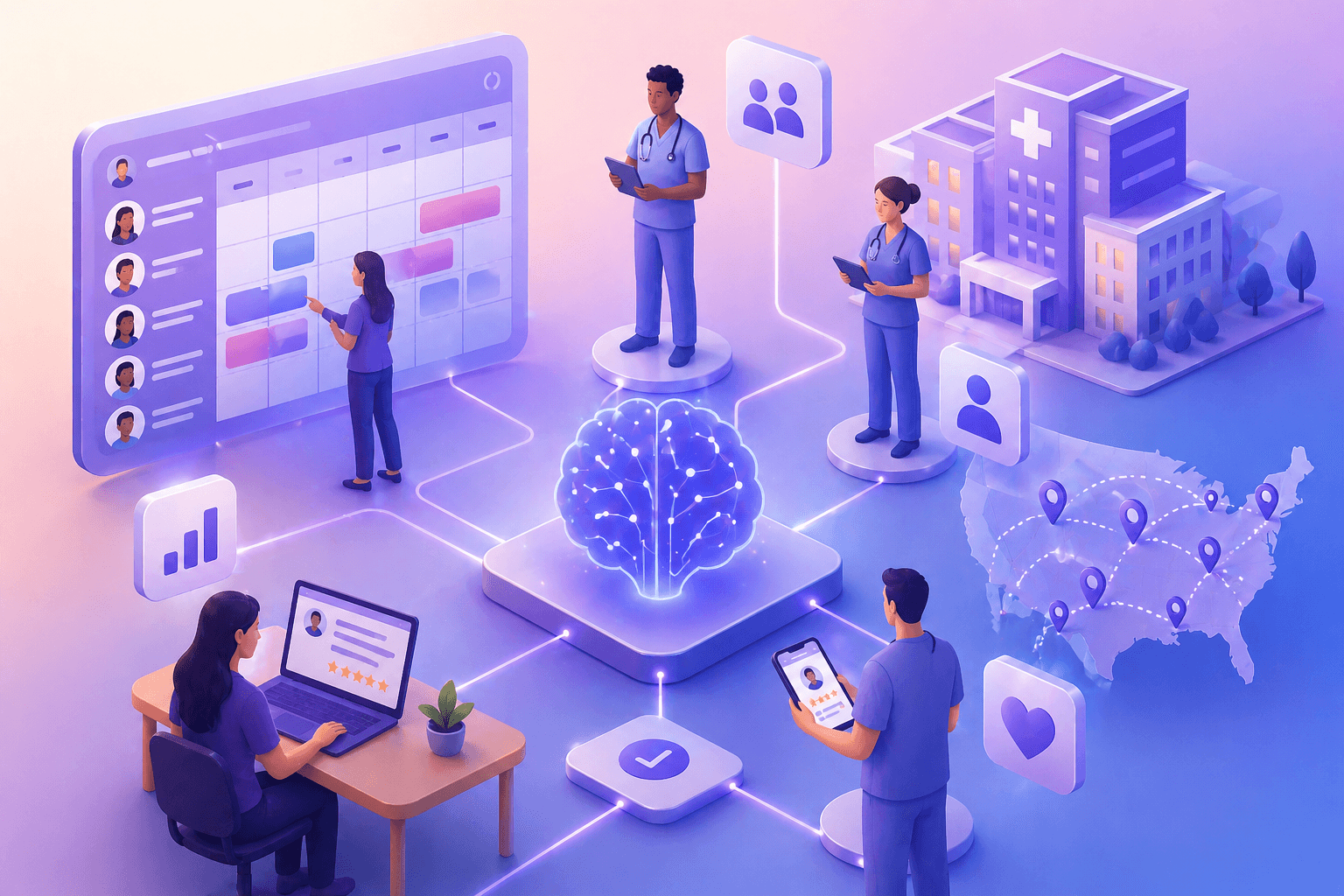
Nomad positions its AI OS as a System of Action — a platform that actively executes placements rather than merely recording them. The platform unifies the clinician experience, recruiter workflow, and middle office into a single operating system. Healthcare staffing firms face a market characterised by shrinking margins, growing compliance pressure, and increasing clinician expectations. The software most firms run on was built for a different era — one where growth meant adding recruiters and AI was not a design input. That architecture directly ties cost to headcount and slows the pace of innovation needed to stay competitive. Nomad's platform breaks that link: its AI models and automation handle the high-volume, rules-heavy work of matching and placement — work that previously required recruiting headcount — while giving firms the operational infrastructure to compete in a fundamentally more efficient way.
"Building Nomad from a staffing operator into a true System of Action has been a privilege and incredibly rewarding. Tommy's background in enterprise healthcare software makes him exactly the right leader to scale this infrastructure across the industry."
— Justin Lambert, outgoing Chief Executive Officer, Nomad Health
Key Takeaways
- • Nomad Health (New York City; venture-backed; founded 2015; 2026 DHNY Hall of Fame "Foundational Utility") has announced a formal transition from healthcare staffing agency to software platform company — announced 24 April 2026. Offering its proprietary AI operating system to mid-market and enterprise healthcare staffing firms nationwide. Coinciding appointment of Tommy Hickey as CEO (succeeding Justin Lambert who moves out of the CEO role). Platform available for early access at nomadhealth.ai.
- • What makes Nomad's platform unique — built from the inside out: unlike software vendors who designed tools from the outside in, Nomad built its platform inside a live, high-volume staffing operation. 15,000+ recruiter-less placements made. 11M+ billed hours worked. Platform already reflects 10,000+ client facility rules and years of clinician behavioural data. The decisions made to thrive as a staffing operator are baked into an architecture that no externally-built platform can replicate — because those decisions were made under the pressure of real operational consequences, not theoretical product design.
- • The Nomad AI OS — System of Action: the platform unifies the clinician experience, recruiter workflow, and middle office into a single operating system that actively executes placements — not just records them. AI models and automation handle the high-volume, rules-heavy work of matching and placement. The platform breaks the direct link between headcount and cost that constrains legacy staffing operations — enabling firms to scale without proportionally scaling recruiter headcount.
- • The market problem the platform addresses: healthcare staffing firms face shrinking margins, growing compliance pressure, and increasing clinician expectations. The legacy software stack was built for an era where growth meant adding recruiters and AI was not a design input — tying cost to headcount and slowing innovation. Nomad's platform is built for the AI era: coverage across all healthcare professions and job types; mid-market and enterprise firm focus; infrastructure that enables firms to compete on operational efficiency rather than headcount scale.
- • Strategic significance of the pivot: this is one of the clearest examples of a vertical AI platform company emerging from an operator rather than a software company — Nomad's decade as a staffing operator gave it access to data, rules, and operational insight that no software-first competitor can retrospectively acquire. Tommy Hickey's background in enterprise healthcare software positions him to scale this infrastructure commercially. The platform-as-a-company model — selling the AI OS built to run Nomad's own operations to the broader industry — mirrors the pattern seen in logistics (Flexport), fintech (Stripe), and commerce (Shopify): operators building world-class internal infrastructure, then commercialising it as the market's best platform.