
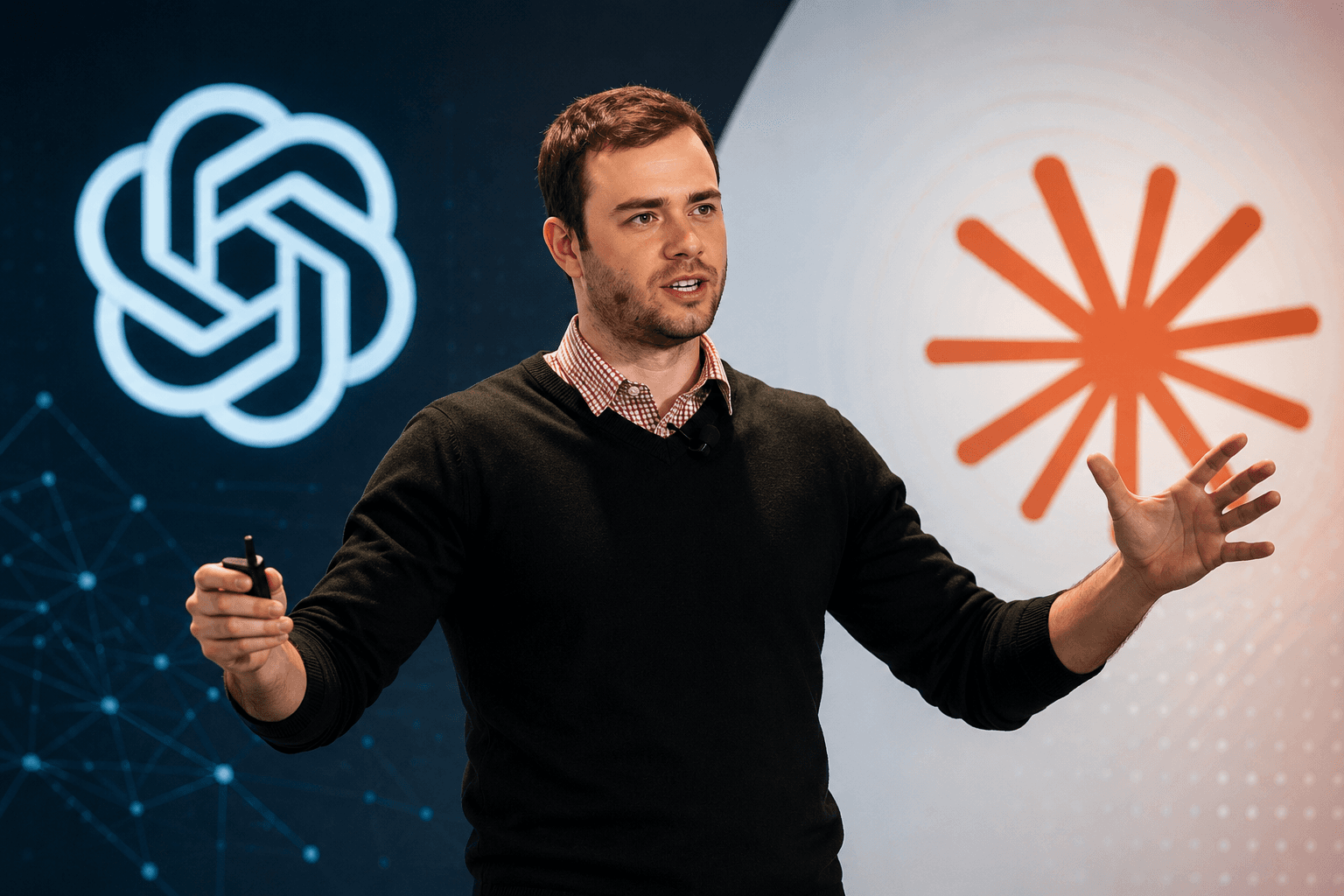
OpenAI's Co-Founder Joins Anthropic. Should HR Leaders Follow?
Andrej Karpathy, one of the most influential AI researchers alive, has joined Anthropic. A founding member of OpenAI's senior research team, Karpathy has worked inside the organisations competing at the frontier of AI — and he chose to bring his expertise to Anthropic at a moment when its valuation has surpassed OpenAI's, its funding position is strong, and its research direction is accelerating.
For HR leaders currently using OpenAI products — or evaluating whether to — this move raises a pointed question: should HR follow Karpathy's lead and switch to Claude? This piece presents the case for switching, the case for staying, and the framework HR leaders need to make the right call for their organisation.
"When the talent is moving toward Anthropic, and when the valuation and funding are moving in the same direction, HR leaders need to ask whether their AI tools should follow."
— peopleHum Editorial AnalysisWhy Karpathy's Move Matters to HR Leaders
Most coverage of this move has focused on what it means for the AI research landscape. But the lens HR leaders should apply is different: Karpathy is one of the most informed individuals in the world about the internal workings, culture, and trajectory of frontier AI organisations. He has worked inside OpenAI, left, founded his own AI education startup Eureka Labs, and now chosen to join Anthropic specifically to work on the foundational stage of building large language models.
The AI tools HR functions use for payroll, onboarding, performance analytics, and workforce planning are powered by models built by precisely these organisations. The quality, reliability, safety, and governance of those models directly affect the quality, reliability, safety, and governance of the HR outcomes they produce. A talent signal of this magnitude belongs in the vendor evaluation conversation.
"An organisation that maintains its stated values under significant commercial pressure is demonstrating something that mission statements alone cannot prove."
— peopleHum, May 2026The Case For Switching to Claude
Anthropic was founded by former OpenAI executives who left specifically over concerns about AI safety. That founding motivation has produced a research and product philosophy that prioritises reliability, honesty, and predictability of AI outputs — qualities that are not abstract values for HR functions processing sensitive employee data and making consequential decisions about careers and compensation. They are operational requirements.
Anthropic's refusal to drop its ethical red lines around mass surveillance and autonomous weapons is a meaningful data point. So is the trajectory of its talent. The quality of the team building Claude is a reasonable indicator of the quality of the tool the team will continue to produce — and that team has been drawing experienced, senior professionals from leading AI organisations at an accelerating pace.
The Case Against Switching — and What HR Should Actually Do
The case for staying with OpenAI products is equally real. HR AI tools are not plug-and-play. They are integrated into HRIS systems, payroll platforms, onboarding workflows, and performance management processes. Switching means revisiting integrations, retraining staff, and managing a transition period with genuine operational risk. OpenAI also has a larger installed base and a longer enterprise track record — the edge cases and failure modes of its tools are better understood because more organisations have been using them for longer.
Critically, a talent move is not a product review. Karpathy's decision signals research direction and organisational culture. It does not directly determine which tool performs better for specific HR use cases today. The practical decision is not binary. HR leaders should evaluate Claude specifically for the use cases where AI reliability matters most — performance assessment, compensation recommendations, disciplinary process support, and workforce planning — while using that evaluation process to ask harder governance questions of all existing vendors. Platforms like peopleHum, which build AI-powered HR functionality on top of leading models and manage the integration and HR-specific configuration, allow HR leaders to benefit from the best underlying AI without managing vendor complexity directly.
A major talent signal worth reading. Andrej Karpathy — one of the most informed individuals alive on frontier AI — left OpenAI and joined Anthropic. HR leaders evaluating AI vendors should treat this as a meaningful input into their assessment.
AI model quality determines HR outcome quality. The models powering HR functions directly shape the reliability, safety, and governance of the decisions those functions produce. When talent, valuation, and funding align toward one organisation, HR infrastructure questions follow.
Four grounds for switching to Claude. Anthropic's safety-first founding philosophy, demonstrated ethical consistency under commercial pressure, accelerating talent trajectory, and Claude's enterprise design for predictable, compliance-safe outputs.
Switching is not simple — and shouldn't be rushed. HR AI tools are deeply integrated into HRIS, payroll, and performance systems. OpenAI's larger installed base and longer enterprise track record are real advantages that switching costs must be weighed against.
The practical decision is not binary. Evaluate Claude for your most reliability-sensitive HR use cases, use that process to demand better governance answers from all vendors, and consider HR platforms that manage AI integration so you don't have to.