
What the AI Hiring Conversation Keeps Getting Wrong
The debate over AI in hiring has grown louder — and in many ways, more muddled. Fear and caution are dominating the discussion, while several points HR leaders genuinely need to hear are getting drowned out. According to Courtney Dutter, General Counsel and Chief Compliance Officer at ICIMS, those overlooked points might even shift how HR teams think about adopting AI in their hiring processes.
Bias in Hiring Did Not Start With AI
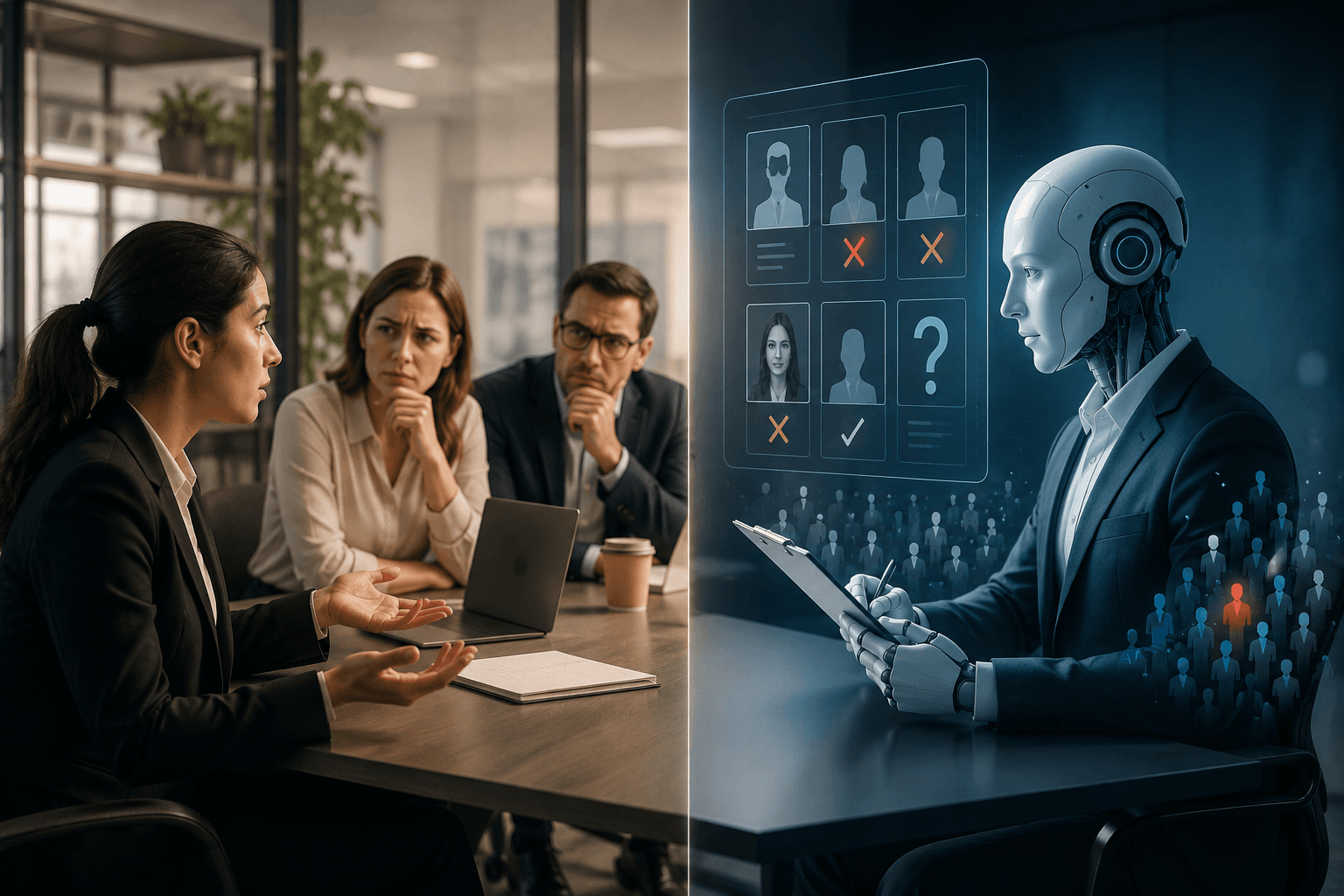
The loudest claim in the debate is that AI has injected bias into hiring. Dutter pushes back on that framing: discriminatory hiring practices were being raised by candidates for nearly two decades before AI arrived. Every human involved in screening brings conscious and unconscious bias to the table — the difference now is that AI can actually be tested for it.
A recruiter making gut calls on a resume stack offers no reliable way to measure or explain the decision process. An algorithm, by contrast, can be audited: disparate impact can be measured across demographic groups, training data can be inspected, and outputs can be documented and reviewed. We're holding AI to a standard never applied to human judgment — and when responsibly designed and governed, AI can bring consistency to a process that has always struggled with it.
We hold AI to a standard we've never applied to human judgment — and that double standard deserves scrutiny.
— Courtney Dutter, General Counsel & Chief Compliance Officer, ICIMS (paraphrased)The Law Already Applies — There's No Need to Wait
Much of today's compliance hesitation centers on emerging rules like the EU AI Act and a growing list of state-level AI laws. Tracking those is smart — but existing anti-discrimination laws have applied to every hiring decision for decades, including decisions informed by AI. New technology didn't create that obligation; it simply added a new place where it can be violated.
Yet ICIMS research shows 45% of organizations still have no formal AI governance framework in place. Waiting for comprehensive AI legislation before building one is waiting for the wrong thing: when new laws arrive, they'll largely demand practices companies should already have. Programs can then evolve to meet whatever fresh requirements emerge.
Most Organizations Don't Understand What They're Buying
The most striking gap, in Dutter's view, is that many organizations evaluate AI hiring tools without a clear grasp of how they actually work. Per the same ICIMS study, 58% of talent acquisition leaders can't even distinguish AI from simple automation. Essential governance questions — What data trained the model? Which attributes are included or excluded? Can outputs be explained? Has the tool been bias-tested? What does human oversight look like in the workflow? — belong in every procurement conversation and vendor review.
Legal teams often zero in on indemnification clauses and liability terms during vendor calls. Those matter, but if nobody has asked how the model works, it's impossible to know where the risk actually sits. Deep understanding of AI tools goes beyond compliance: it's what lets HR teams stand behind their process, catch the tool when it errs, and course correct. That's how a hiring program earns real trust.
The conversation around AI in hiring needs to get harder and more specific — not more fearful.
— Courtney Dutter, General Counsel & Chief Compliance Officer, ICIMS (paraphrased)The Anxiety Will Settle — But the Foundation Must Be Built Now
When enterprise software first moved to the cloud, security and accountability fears ran high. As governance frameworks matured, those concerns became manageable — and cloud adoption is now unremarkable. AI in hiring is on a similar curve. In two or three years, organizations that built thoughtful governance, invested in understanding their tools, and kept humans meaningfully in the loop will look back on today as the moment the foundation was laid. Those still waiting for perfect regulatory certainty will have spent that time falling behind — and may have already lost the trust of the candidates and employees they serve.
Bias predates the algorithm. Hiring bias existed long before AI — the real change is that AI decisions can be audited, measured for disparate impact and explained, unlike human gut calls.
Existing laws already apply. Anti-discrimination obligations have covered every hiring decision for decades, including AI-informed ones — there's no reason to wait for new AI legislation to build governance.
Governance gap is real. ICIMS research finds 45% of organizations have no formal AI governance framework, and 58% of TA leaders can't distinguish AI from automation.
Ask how the model works. Training data, included attributes, explainability, bias testing and human oversight should be standard questions in every AI vendor review — not just indemnification clauses.
Build the foundation now. Like cloud adoption, AI anxiety will settle — organizations that invest in governance and human oversight today will lead, while those waiting for regulatory certainty fall behind.