
VoicePing Launches VoicePing 3.0 for Enterprise Multilingual Communication
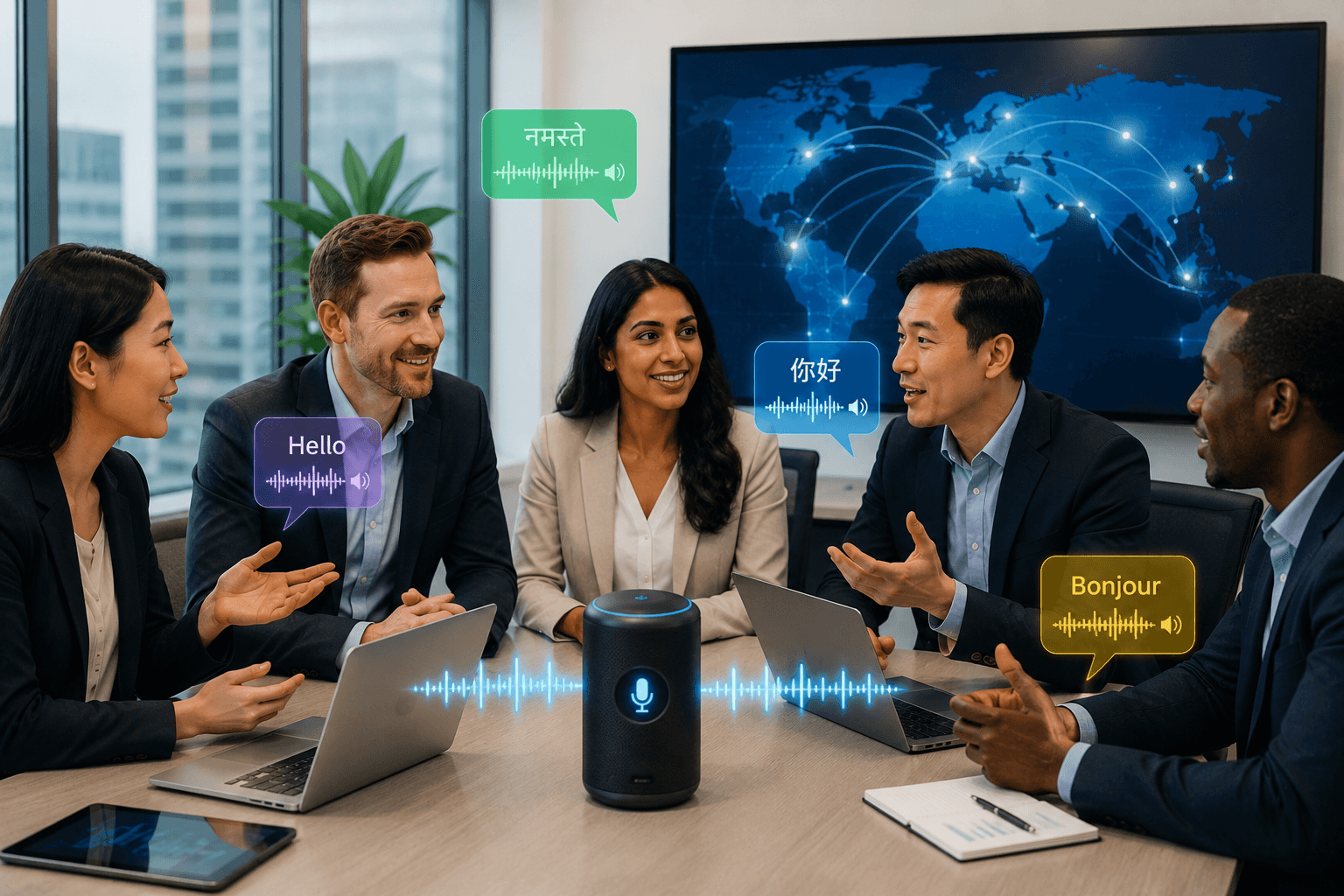
Tokyo-based VoicePing Inc. has announced the general availability of VoicePing 3.0, the newest version of its multilingual AI communication platform built for in-person and web meetings, exhibitions and events, audio and video files, recordings, and virtual offices.
The release targets organizations that need to capture, document, and reuse spoken information across multilingual workplaces. VoicePing 3.0 pulls in audio from meetings, seminars, webinars, external web conferences, recorded files, and hybrid office environments, then turns it into real-time transcription and translation, AI meeting minutes, summaries, action items, and searchable meeting logs.
"Global teams no longer communicate in one place."
— Akinori Nakajima, CEO, VoicePingFrom Scattered Conversations to Searchable Knowledge
VoicePing's pitch is that single-purpose transcription or translation tools can handle individual meetings or files, but fall short for enterprises that must manage multilingual communication continuously. Version 3.0 answers that gap by unifying real-time translation, voice output and AI dubbing, AI meeting minutes, event translation, web meeting capture, file transcription, terminology dictionaries, MCP/API access, virtual office collaboration, analytics, and security administration in a single platform.
Notable new capabilities include translated voice playback, AI dubbing, terminology dictionaries, event QR translation, and MCP/API access that lets approved AI workflows tap into meeting records — a nod to the growing enterprise demand for governed AI integrations.
Nakajima said the platform was rebuilt so enterprises can translate communication in real time, preserve it as searchable knowledge, manage terminology, and connect meeting records to governed AI workflows via MCP and APIs.
— On the vision behind VoicePing 3.0New In-House AI Models with an Asian-Language Focus
Alongside the platform release, VoicePing introduced two proprietary models: VoicePing ASR V0.1, a speech recognition model, and VoicePing MT V0.1, a multilingual translation model. Both power core functions across transcription, translation, subtitles, meeting summaries, and search, with a deliberate emphasis on practical business communication in Asian languages.
In internal benchmarks spanning 5,000 business conversation clips (roughly 41 hours) in English, Japanese, Korean, Chinese, and Vietnamese, VoicePing ASR V0.1 posted an average word error rate of 19.3%. For English–Japanese translation, VoicePing MT V0.1 scored 87.2 in the company's evaluation — performance it says is comparable with major translation models in that setting.
VoicePing 3.0 also ships with a redesigned user experience for clearer multilingual meeting workflows, faster real-time translation responsiveness across display, sharing, playback, and summarization, plus stability, security, and administration updates across desktop, mobile, and enterprise environments.
Platform rebuild. VoicePing 3.0 unifies real-time translation, AI meeting minutes, dubbing, event translation, file transcription, and searchable logs in one enterprise platform.
Beyond single meetings. The platform captures communication across meetings, webinars, events, recorded files, and hybrid offices — positioning multilingual communication as enterprise infrastructure.
AI-workflow ready. New MCP/API access connects meeting records to approved, governed AI workflows, alongside terminology dictionaries and event QR translation.
Proprietary models. VoicePing ASR V0.1 recorded a 19.3% average word error rate across 5,000 multilingual business clips, while MT V0.1 scored 87.2 on English–Japanese translation.
Asian-language edge. Both models prioritize practical business communication across English, Japanese, Korean, Chinese, and Vietnamese — a differentiator in the translation-AI market.