
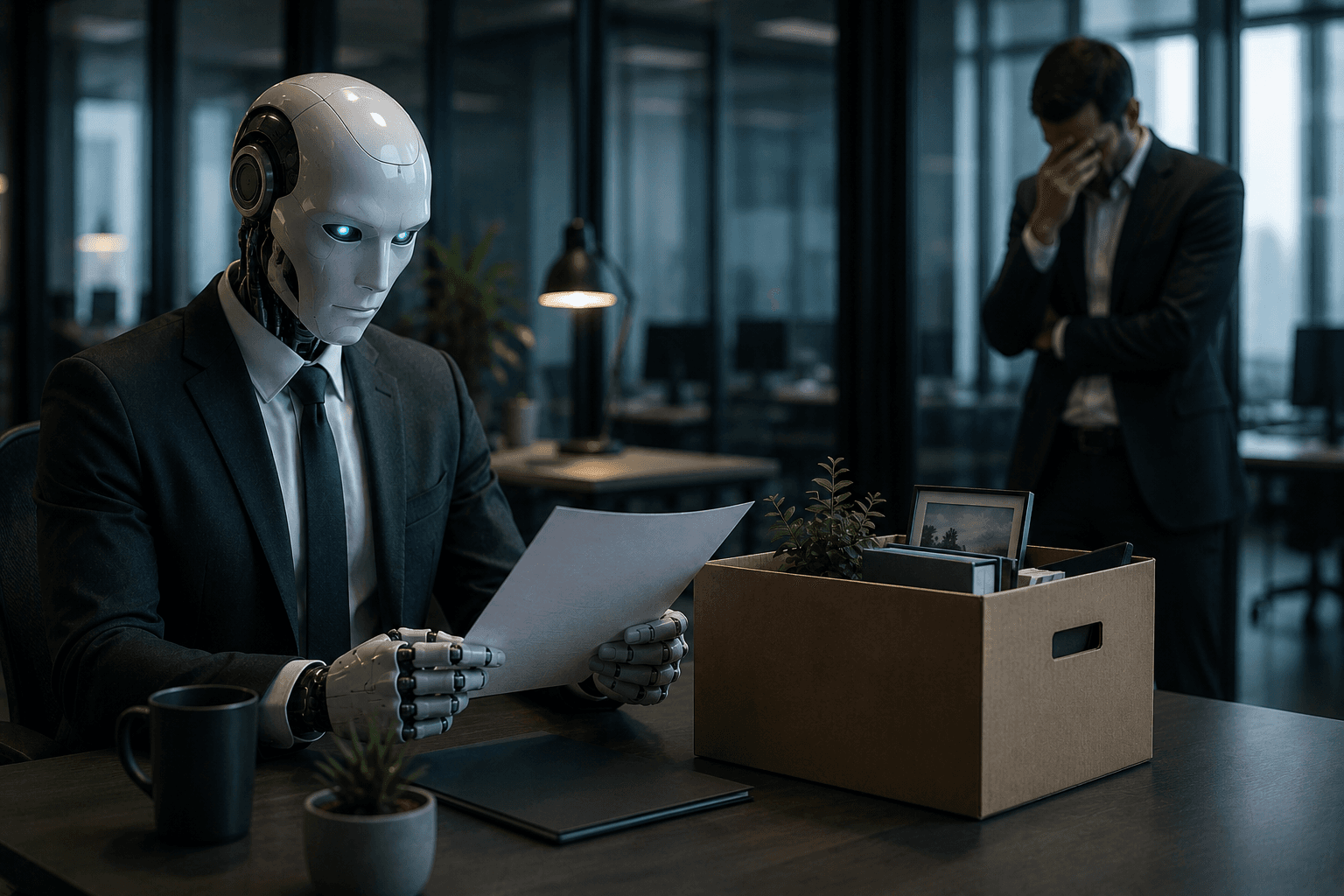
What happens when AI handles the layoffs?
Let's revisit a story from 2025 that is widely circulated in tech circles even today. An anonymous Microsoft engineer who had spent more than two decades in the company, and who, according to his colleagues, worked long weeks fixing bugs and mentored young developers, was unceremoniously fired during the 2025 round of layoffs. Why? Because a system reviewing his performance data put him in the "low impact" category.
AI is no longer just screening resumes or scheduling shifts. In many organisations, it is now involved in deciding who loses their job. This shift raises an important question: can software actually be trusted to make a decision this consequential, and who takes the blame when it gets a decision wrong?
"AI can process the layoff faster. It has not yet proven it can process the fairness question the same layoff decision requires."
— From the reportCan AI handle layoffs in practice, or only in theory?
Going simply by theory, AI is well suited to handle layoff decisions. It can process performance data, tenure, cost, and project impact across thousands of employees faster than any human team could. When applied in practice, however, the picture becomes considerably more complicated.
Looking at the data, AI-attributed layoffs reached 55,000 people in 2025, more than twelve times the number just two years earlier, according to layoff tracking site Layoffs.fyi. By mid-2026, tech companies alone had announced roughly 363 separate layoffs affecting nearly 150,000 workers, a pace about 44% faster than the same period in 2025, based on data from layoff tracker TrueUp.
But volume is not the same as accuracy. A growing body of legal cases suggests AI-driven layoffs are producing outcomes companies did not intend, and could not fully explain. This is where the theory and the reality begin to diverge. The theory says AI removes bias and speeds up hard decisions. The reality says AI can just as easily encode and scale the exact bias it was supposed to eliminate.
What are some of the pros and cons of letting AI handle layoffs?
The pros: Faster processing of large-scale workforce data across thousands of employees at once; removal of manager bias in performance reviews; consistency in applying the same criteria across every employee in every department; and cost savings that some companies are reinvesting directly into AI infrastructure.
The cons: Systems trained on historical data can absorb and scale old patterns of bias rather than remove them. Twenty-six former and current Meta employees have alleged the company used AI systems to help rank and select staff for a 10% layoff without properly accounting for protected leave or disability status, according to Bloomberg Law's July 2026 coverage. Decisions can happen without the direct human review that used to catch obvious errors. And even companies posting strong profits are citing AI as the reason for cuts, which some analysts call "AI redundancy washing" — using automation as a convenient explanation for decisions really driven by cost-cutting or strategy shifts.
The pattern across this data is consistent. AI can process the layoff faster. It has not yet proven it can process the fairness question the same layoff decision requires.
How do employees actually feel about AI making this call?
Workers affected by AI-influenced layoffs have revealed that, in some cases, they were asked to document their own workflows to help train the systems that later replaced them.
A 2026 analysis by HeroHunt covering 272 surveyed former employees noted 62% of those affected were over 40, and 22% had more than 15 years of tenure, suggesting the employees whose accumulated knowledge was most valuable to extract were also the ones most likely to be cut once that knowledge had been encoded into a system.
This matters for retention and trust well beyond the employees who are actually let go. Watching a colleague lose their job to a system, with no one taking any visible accountability behind the decision, changes how remaining employees experience their own job security.
"An unfair reason for dismissal does not become acceptable simply because a system identified it instead of a manager."
— Pinsent Masons legal analysis, 2026Is it even legal? What do labour laws say about this?
South Africa's Labour Relations Act requires every dismissal to be both substantively fair, meaning there is a valid reason related to conduct, capacity, or operational needs, and procedurally fair, meaning the correct steps were followed before termination. Using AI to make the decision does not change this requirement at all.
A few specific protections matter here for any company operating across the continent:
Automatic unfairness still applies regardless of who makes the call: In South Africa, a dismissal is automatically unfair if it is linked to discrimination or infringes a constitutionally protected right, no matter whether a human or an algorithm triggered it.
Procedural fairness requirements do not disappear: Employees generally still have the right to a fair process, including the opportunity to respond, before a dismissal is finalised.
Enforcement bodies: South Africa's CCMA handled more than 10,000 labour law complaints in a single recent year, and a dismissal found automatically unfair can result in compensation up to 24 months' remuneration.
Courts are actively grappling with AI's role: Legal analysis from Nigeria notes courts across Africa are already issuing rulings that assess whether AI-driven hiring or termination could expose companies to liability.
In plain terms: no labour law currently allows a company to say "the algorithm decided" as a legal defence. If the underlying reason for the layoff would be unfair coming from a manager, it stays unfair coming from a system. The law does not care what made the decision. It cares whether the decision was fair and properly documented.
Conclusion
What this data makes clear is that AI has not solved the hardest part of a layoff. It has only made the decision faster to make and harder to explain afterwards. A model can rank employees by cost, output, and risk in seconds. But it cannot sit with a 20-year employee and absorb the weight of ending his livelihood.
Organisations getting this right treat AI as a tool that surfaces data for a human decision-maker to weigh. Every African jurisdiction with meaningful labour protection already requires that a human be able to explain and defend the reasoning behind a dismissal. Companies that let AI make the call without that human layer are not moving faster than the law. They are simply building the exact evidence a labour court will use against them, one automated decision at a time.
Volume is not accuracy. AI-attributed layoffs reached 55,000 people in 2025, more than twelve times the number two years earlier. A growing body of legal cases suggests these cuts are producing outcomes companies did not intend and could not fully explain.
Bias gets scaled, not removed. AI can process a layoff faster, but it has not proven it can process the fairness question. Systems trained on historical data absorb and scale existing bias rather than eliminate it.
The most experienced get cut. Employees asked to document their own workflows to train AI were, in some cases, cut once that knowledge was encoded. 62% of affected workers in one 2026 survey were over 40, and 22% had more than 15 years of tenure.
"The algorithm decided" is no defence. No labour law allows automation to excuse an unfair dismissal. Procedural and substantive fairness requirements remain fully in force whether a human or a system triggered the call.
Keep a human in the loop. AI has made the decision faster to make and harder to explain. Companies letting AI make the final call without a human layer are building the evidence a labour court will use against them.