
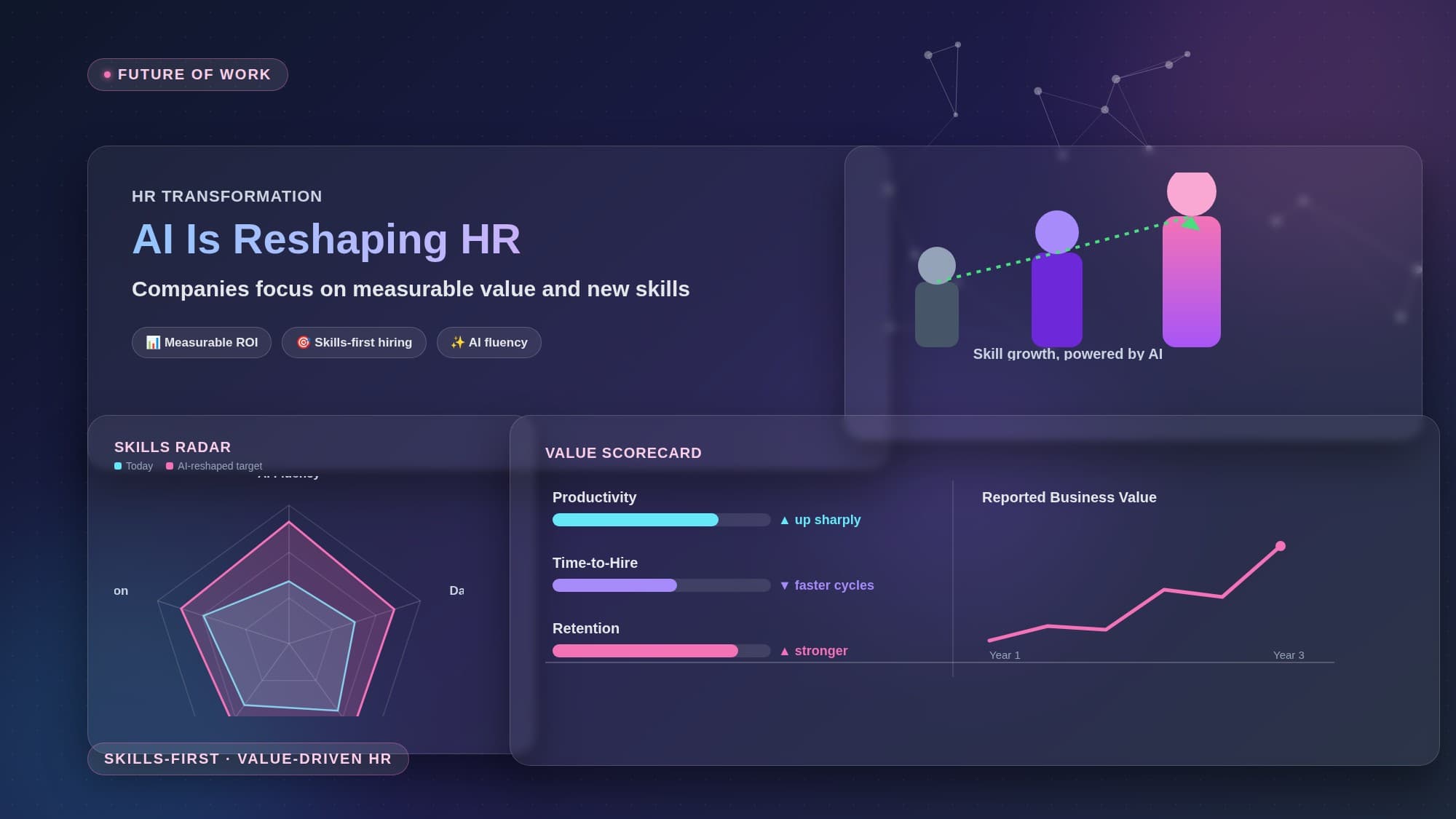
The growing use of artificial intelligence is changing how organizations think about work, talent, and the role of human resources.
A new report from AIHR finds that companies are increasingly focused on measuring the business value of AI while redesigning jobs and workflows around the technology. As these changes accelerate, demand is shifting toward HR capabilities such as technology, analytics, organizational effectiveness, and change management.
AIHR has also released a companion report, HR Priorities 2027, outlining how HR leaders can respond to these changes.
“AI is changing where HR creates value,” said Erik van Vulpen, Co-Founder and Dean of AIHR. He noted that organizations are placing greater emphasis on judgment, specialized expertise, and the ability to lead transformation.
Demand for New HR Skills Is Growing
AIHR's analysis of U.S. labor data, conducted with Revelio Labs, covers 54 HR roles, more than 162,000 active U.S. HR job postings, and 3.88 million HR professionals.
The data shows particularly strong growth in roles connected to organizational transformation.
Demand for Organization Effectiveness Specialists increased 65.4%, while demand for Change Management Specialists grew 21.6%.
At the same time, some specialized roles face significant talent shortages. AIHR estimates that there are only five HR Technologists available for every job opening.
Demand is moving in the opposite direction for several administrative roles. HR Administrator positions declined 29.6%, while HR Service Desk Agent roles fell 38.3%.
Dr. Marna van der Merwe, AIHR's Research & Insights Lead, said the decline in routine and entry-level work creates a challenge for developing experienced HR professionals. As traditional career-building responsibilities change, organizations may need to rethink how employees develop business knowledge, judgment, and HR expertise.
Companies Are Moving From AI Adoption to Measurable Results
As AI becomes more common across organizations, simply adopting the technology is no longer enough. Companies are increasingly asking how AI can deliver measurable business value.
AIHR's research across 334 HR teams shows a similar gap within HR departments.
While 65% of teams demonstrate strong support for AI adoption, only 30% have clearly defined AI purposes, expected outcomes, and relevant use cases.
Only 29% are confident that they have the data, technology, and infrastructure needed to deploy AI at scale.
Additional research covering 961 HR teams and 13,665 HR professionals found gaps in areas including digital agility, data literacy, business acumen, workforce planning, and job design.
Only 30% of HR professionals have received AI training specific to their jobs.
Together, these findings suggest that achieving measurable AI value requires more than purchasing new tools. Organizations also need clear use cases, reliable infrastructure, and employees capable of redesigning work around the technology.
HR Is Being Asked to Lead Workplace Transformation
As businesses introduce AI into more workflows, HR is increasingly expected to help redesign jobs, develop workforce capabilities, and prepare employees for organizational change.
The shift is already affecting HR operating models. According to AIHR, 64% of HR functions changed their operating models during the past two years.
However, the transition has not always been clearly defined. Only 19% of HR functions report having clear responsibilities across HR Business Partners, Centers of Excellence, and shared services.
Among organizations that reorganized, 60% did not provide formal training on the new operating structure.
There is also a mismatch between where HR invests and where talent demand is growing.
Approximately 59% of HR payroll is concentrated in role families with more than 100 available professionals per opening. Meanwhile, HR Technology, Digital, and People Analytics account for only around 1.9% of payroll, despite being among the areas experiencing tighter talent markets.
Administrative work remains another challenge. Around 51% of HR leaders identify administrative workload as a strategic barrier that limits their ability to invest in higher-value capabilities.
Five Priorities for HR Leaders
AIHR's companion report, HR Priorities 2027: Redesigning for the Future, translates these trends into five priorities for HR leaders:
Redesign work for human-AI performance
Treat talent as an enterprise-wide capability
Define shared workforce decision-making authority
Redesign HR operating models for human-AI delivery
Direct investment toward capabilities with the highest potential return
Together, the two reports highlight a broader shift in HR.
AI is not simply introducing another technology into the workplace. It is changing which skills organizations need, how jobs are structured, and where HR can create value.
For HR leaders, the challenge for 2027 will therefore extend beyond AI adoption. It will be about redesigning work, developing the right capabilities, and creating measurable value from the combination of people and technology.