
Can AI Really Remove Biases from Employee Hiring?
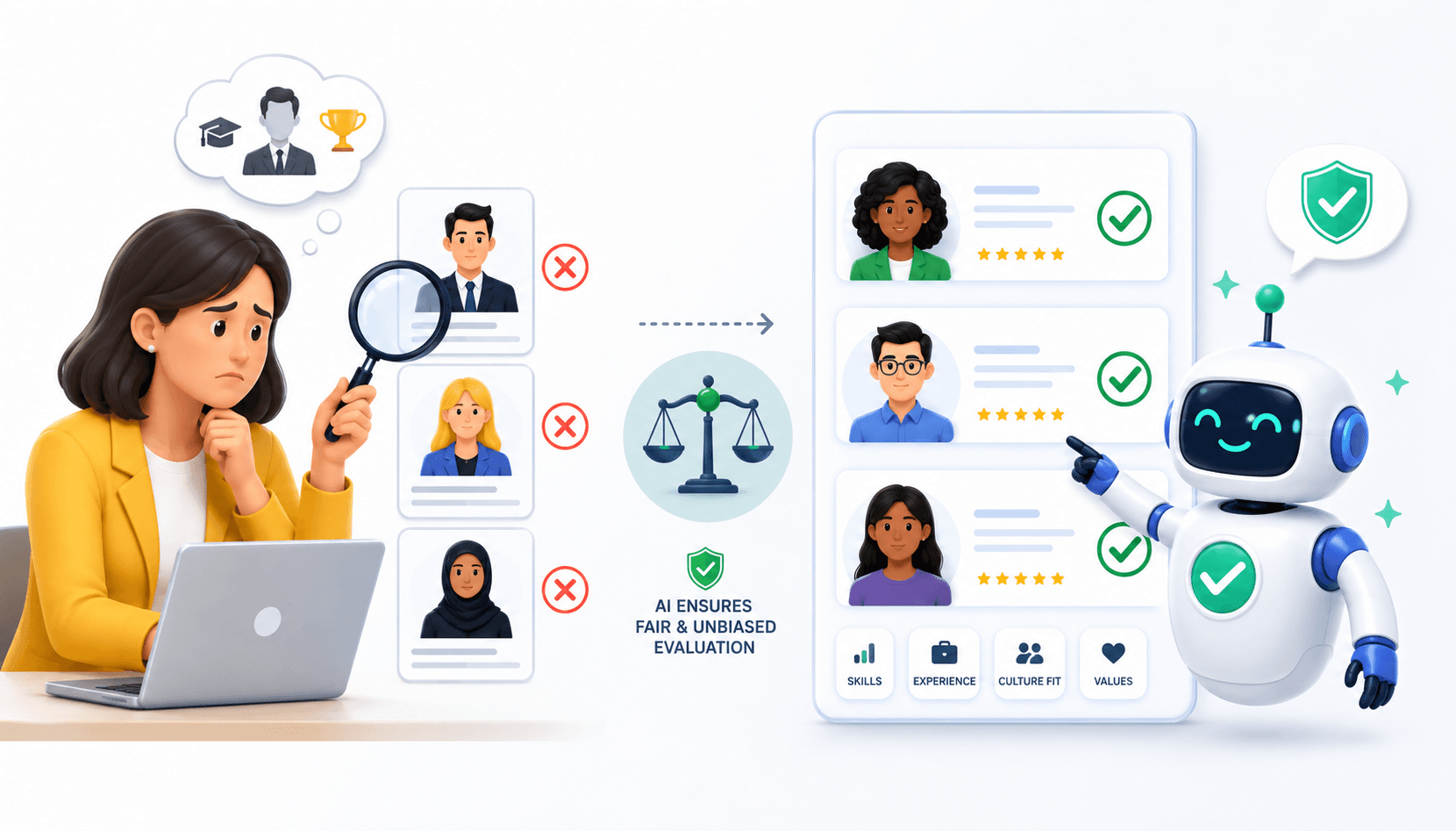
What if the tool you trusted to make hiring fairer was quietly making it less fair? That is the question HR teams using AI in employee hiring need to ask themselves. Not because AI is inherently dangerous, but because the promise of bias-free hiring through AI is more complicated than most vendors let on. The answer is yes — AI can reduce bias — but with terms and conditions that matter enormously.
"AI is neither the enemy of fair hiring nor its automatic solution. It is a mirror — reflecting the quality of the decisions made by the people who build and deploy it."
— Team peopleHum, peopleHum BlogWhere Hiring Bias Actually Comes From
Hiring bias is not always deliberate. It lives in the small, fast decisions that happen before a recruiter has even consciously formed an opinion. A recruiter sees a name on a resume, reads the name of a university, or notes a previous employer — and makes an assumption. None of this is conscious. All of it influences the outcome.
Research published in the Proceedings of the National Academy of Sciences found that resumes with traditionally white-sounding names received significantly more callbacks than identical resumes with traditionally Black-sounding names. Harvard Business Review has documented that women are evaluated more harshly than men for the same leadership behaviours. Hiring bias is structural, cultural, and deeply human — baked into the decisions that shaped today's workforce. And that is precisely where AI's problem begins.
The Core Criticism: AI Learns from Biased Data
The most important argument against AI in hiring is straightforward: AI learns from historical data, and historical data reflects historical bias. When trained on a company's past hiring decisions, AI learns to replicate those decisions. If the company historically hired mostly men for senior roles, the AI learns that male candidates are a better fit. If it promoted candidates from elite universities, the AI learns to do the same.
Amazon discovered this directly. The company scrapped an internal AI recruiting tool in 2018 after finding it systematically downgraded resumes that included the word "women's" — as in "women's chess club" — and penalised candidates from all-female colleges. This is a legitimate and serious concern. But it is not the end of the story.
"The problem with Amazon's tool was a governance failure — not a technology failure. Human recruiters also operate from biased data, and unlike AI, they cannot be audited, pre-tested, or corrected before deployment."
— Team peopleHum, peopleHum BlogHow AI Can Actively Reduce Hiring Bias
When designed with intent, AI offers fairness capabilities that human recruiters simply cannot replicate. Blind screening: AI tools can evaluate candidates without access to name, gender, age, address, photograph, or any other demographic marker. A well-designed screening tool never sees those details in the first place — research from the National Bureau of Economic Research shows blind resume screening consistently increases callback rates for underrepresented candidates.
Consistent criteria at scale: A recruiter conducting twenty interviews in a day applies different standards to the first candidate and the twentieth — fatigue, mood, and order effects all introduce variability. AI applies the same criteria to every candidate, every time. Beyond that, AI can detect systemic patterns in hiring outcomes that human analysis would miss: candidates from certain zip codes consistently screened out, or job descriptions written in language that attracts applications from a narrow demographic. These are structural biases human recruiters are poorly positioned to notice.
The Conditions That Make Bias Reduction Possible
AI reduces hiring bias under specific conditions. When those conditions are absent, it amplifies bias instead. Training data must be audited and cleaned before the tool is built — historical inequities in roles, titles, and success metrics must be identified and corrected. The definition of success must be examined: if success is defined as employees who were promoted in the last decade, and those employees were disproportionately from certain backgrounds, the AI will favour those backgrounds.
Regular bias audits must be built into the process after deployment, since a tool that performed fairly at launch may drift over time as it is exposed to new data. Human oversight must be preserved — AI should inform hiring decisions, not make them. The final decision on every hire should involve a human who can exercise judgment and override an AI recommendation when the situation warrants it. And transparency with candidates is not optional: candidates have a right to know when AI is being used to assess them, and transparency creates the accountability that drives better governance.
AI doesn't remove bias by default. Under poor governance it amplifies existing bias; under good governance it can outperform human hiring for fairness. The difference lies entirely in how it is built and managed — not in the technology itself.
Amazon's case was a governance failure. The 2018 scrapped recruiting tool penalised candidates from all-female colleges because it learned from a male-dominated hiring history. The lesson is not that AI cannot be fair — it is that organisations must do the hard governance work before deployment.
Human recruiters are not a neutral alternative. They cannot unsee demographic details on a resume, cannot audit their own unconscious associations, and cannot apply consistent criteria across hundreds of candidates affected by fatigue and interview order. AI can do all three when designed to.
Four conditions enable fair AI hiring. Training data must be audited and cleaned; success must be defined without replicating historical inequity; regular bias audits must be conducted post-deployment; and human oversight must be preserved so AI informs rather than makes decisions unilaterally.
AI is a mirror, not a magic fix. It reflects the quality of the decisions made by the people who build and deploy it. The technology is ready to make hiring fairer — the question is whether HR teams are willing to demand and govern the conditions that make that possible.