
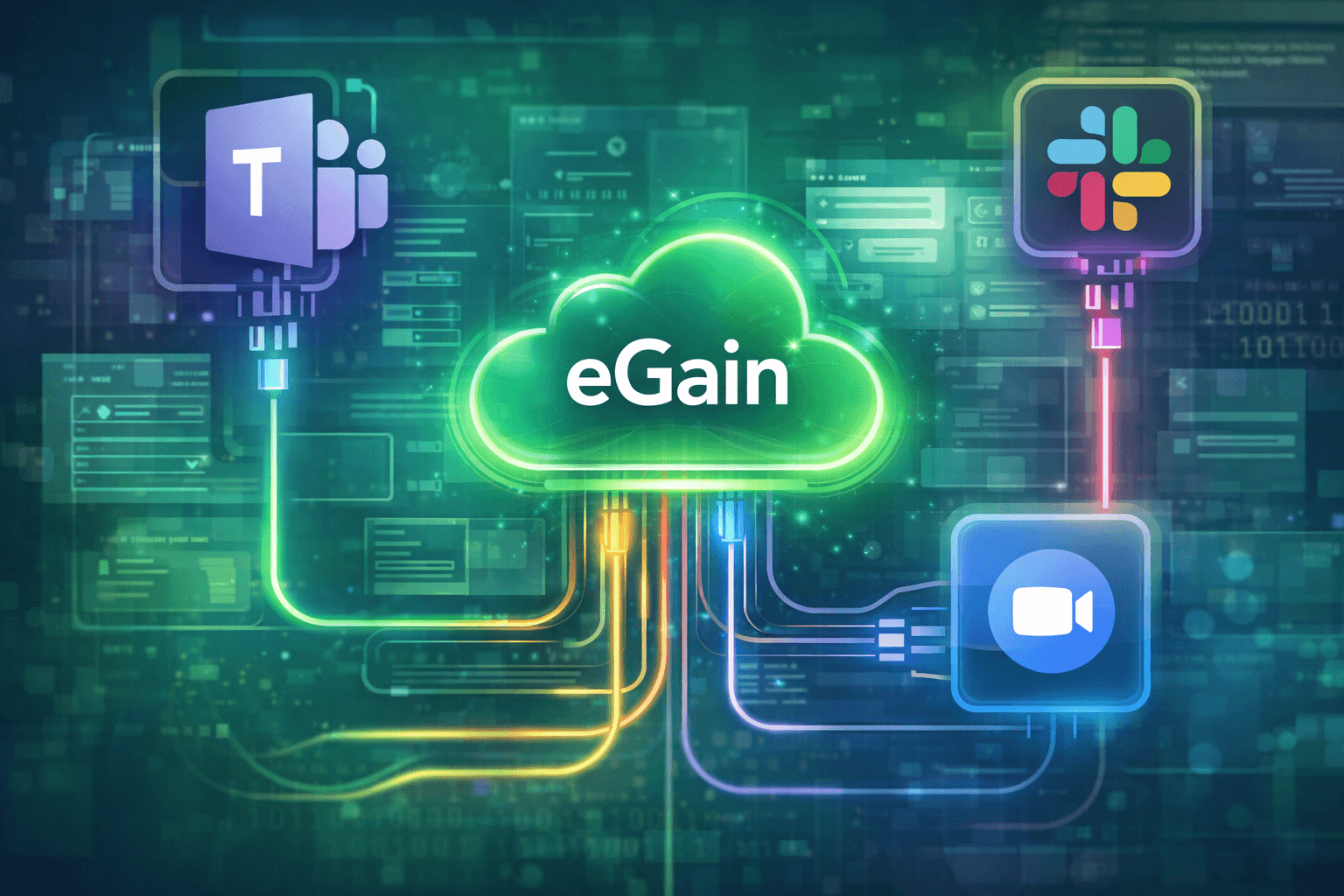
eGain Brings Its AI Agent Into Microsoft Teams, Slack, and Zoom Team Chat — Delivering Accurate, Policy-Grounded Answers and Assured Actions Inside the Collaboration Platforms Employees Already Use Every Day
The new integrations connect eGain's single governed knowledge foundation — with source citation, role-based access controls, case-based reasoning for deterministic compliance answers, and MCP-integrated Assured Actions for full task completion — directly into the UCaaS and CCaaS environments where employees spend the majority of their working day, eliminating the productivity drain of cross-system searches and reducing escalations to HR, operations, and support teams.
4 min read
eGain (Nasdaq: EGAN) has announced new integrations that bring eGain AI Agent into Microsoft Teams, Slack, and Zoom Team Chat — delivering accurate, compliant answers and AI-powered actions directly inside the collaboration tools that employees already use as their primary daily workspace. The integrations address a productivity friction point that has persisted even as organisations have broadly adopted both AI and collaboration platforms: employees still lose significant time searching across disconnected systems for the policies, procedures, and how-to information they need to do their jobs confidently. By embedding eGain AI Agent inside Teams, Slack, and Zoom, organisations can now surface that knowledge at the point of need — without asking employees to context-switch to a separate knowledge portal or service desk.
Trusted Knowledge With Source Citations — Why Governance Matters as Much as Speed
The central design principle of the eGain AI Agent integrations is that every answer is grounded in a single, governed knowledge foundation — updated, approved, and version-controlled — rather than generated from unverified sources or a fragmented mix of department-maintained documents. When an employee asks a question inside Teams, Slack, or Zoom, the response follows the organisation's current policies and procedures, and each answer cites the specific source documents it draws on, so employees can verify the guidance and dig deeper when the situation requires it. This combination of governed knowledge and source citation addresses one of the most common failure modes of AI assistants in enterprise environments: responses that sound authoritative but are grounded in outdated, unverified, or inconsistent information, leading to policy errors and eroded employee trust in the system.
For compliance-sensitive and high-stakes interactions — regulatory questions, procedural guidance in financial services, HR policy interpretation — eGain AI Agent applies case-based reasoning (CBR) to deliver deterministic answers grounded in the organisation's knowledge, history, and processes. This is a technically meaningful distinction: rather than relying solely on probabilistic language model generation, CBR grounds answers in structured cases and established precedents, providing the consistency and explainability that compliance-sensitive contexts demand. The result is AI guidance that can be demonstrated to follow documented organisational processes — a requirement that generic LLM assistants cannot reliably satisfy.
"Teams, Slack, and Zoom have become the daily workspace for employees. By bringing eGain AI Agent and trusted knowledge into these environments, we help organisations strengthen communication, improve consistency, and give employees the answers and actions they need. It's how we're putting AI to work across any UCaaS or CCaaS platform."
— Ashu Roy, CEO, eGain
Role-Based Access and Personalised Answers — Without Separate Knowledge Base Maintenance
The integrations respect the roles and access rules that organisations already define across their existing systems. A sales employee receives only the information appropriate to their function; HR or finance-specific guidance remains protected and inaccessible to those without appropriate permissions. This role-awareness serves two purposes simultaneously: it delivers personalised, contextually relevant answers that reflect what each employee actually needs, and it prevents sensitive content from being surfaced to unauthorised users — a governance requirement that becomes more critical as AI systems are granted access to broader organisational knowledge bases. Importantly, this architecture also eliminates the need for individual departments to maintain separate knowledge bases for their AI tools, allowing organisations to scale AI-assisted answers across functions without duplicating content management overhead or creating knowledge fragmentation at the departmental level.
Assured Actions and MCP Integration — From Answers to Auditable Task Completion
Beyond answering questions, the integrations support eGain's Assured Actions capability, enabling service agents and employees to act on AI guidance directly within their collaboration environment — from quick summaries for straightforward requests to full task completion for complex or compliance-related interactions. Assured Actions integrate with MCP (Model Context Protocol) and standard APIs, providing a verified, auditable confirmation trail for every interaction. This auditability is commercially significant for organisations operating in regulated industries: the ability to demonstrate not just what answer was given but how it was produced, what source it was grounded in, and what action was taken on its basis is increasingly a compliance and risk management requirement rather than a nice-to-have feature.
The real-world validation of the integrations is already in evidence. Hundreds of eGain's own employees use eGain AI Agent for Microsoft Teams to handle HR and workplace questions — including checking paid time off balances, confirming holidays, and locating benefits information — reducing repeated questions to HR teams and demonstrating measurable productivity gains at pace. In a separate deployment, a large financial services organisation uses the Teams integration to give operations teams direct access to accurate, policy-grounded regulatory and procedural guidance at the moment it is needed, without requiring an escalation or ticket to a centralised knowledge team. More information about the integrations is available at egain.com.
Key Takeaways
- eGain has launched new integrations that bring eGain AI Agent into Microsoft Teams, Slack, and Zoom Team Chat — delivering accurate, policy-grounded answers and AI-powered actions inside the collaboration platforms employees already use as their daily workspace, eliminating the productivity drain of cross-system knowledge searches and reducing escalations to HR, operations, and support teams
- Every answer is grounded in a single governed knowledge foundation — updated, approved, and version-controlled — with source citations included so employees can verify guidance and dig deeper as needed; for compliance-sensitive interactions, case-based reasoning (CBR) delivers deterministic, process-grounded answers rather than probabilistic generation, meeting the explainability and consistency standards that regulated industries require
- Role-based access controls inherited from existing enterprise systems ensure each employee receives only contextually relevant, permission-appropriate answers — simultaneously delivering personalised guidance and preventing sensitive content exposure, while eliminating the need for departments to maintain separate knowledge bases and reducing content management overhead across the organisation
- Assured Actions — integrated with MCP and standard APIs — extend the capability from answering questions to completing tasks, with a verified, auditable confirmation trail for every interaction; this auditability is a compliance and risk management requirement for regulated industries that generic AI assistants without governed knowledge foundations cannot provide
- Real-world deployment evidence backs the launch: hundreds of eGain employees already use the Teams integration for HR queries including PTO balances and benefits information — reducing repeat questions to HR teams — while a large financial services organisation uses it to give operations teams direct access to regulatory and procedural guidance at the point of need without escalation or ticketing delays