
<!DOCTYPE html>
<html lang="en">
<head>
<meta charset="UTF-8">
<meta name="viewport" content="width=device-width, initial-scale=1.0">
<title>How to Spot Fake AI in HR Software</title>
<style>
body { margin: 0; padding: 24px; background: #f0f4f8; }
.ht-wrap{font-family:'Georgia',serif;max-width:800px;margin:0 auto;background:#fff;color:#1B2A4A;}
.ht-hero{background:#1B2A4A;padding:36px 36px 32px;}
.ht-pills{display:flex;gap:8px;margin-bottom:18px;flex-wrap:wrap;}
.ht-pill-solid{background:#F26522;color:#fff;padding:5px 16px;border-radius:4px;font-size:11px;letter-spacing:1.2px;text-transform:uppercase;font-family:'Georgia',serif;}
.ht-pill-out{border:1.5px solid #00B4C8;color:#00B4C8;padding:5px 16px;border-radius:4px;font-size:11px;letter-spacing:1.2px;text-transform:uppercase;font-family:'Georgia',serif;}
.ht-title{color:#fff;font-size:30px;line-height:1.3;font-family:'Georgia',serif;margin:0 0 20px;font-weight:bold;}
.ht-meta{display:flex;gap:20px;align-items:center;flex-wrap:wrap;}
.ht-meta-item{color:#8DA4BF;font-size:12px;font-family:'Georgia',serif;letter-spacing:0.5px;display:flex;align-items:center;gap:5px;}
.ht-dot{width:4px;height:4px;border-radius:50%;background:#F26522;display:inline-block;}
.ht-body{padding:32px 36px;}
.ht-p{font-size:17.5px;line-height:1.85;margin-bottom:20px;font-family:'Georgia',serif;color:#1B2A4A;}
.ht-link{color:#2E6DB4;text-decoration:underline;}
.ht-strong-o{color:#F26522;font-weight:bold;}
.ht-strong-b{color:#2E6DB4;font-weight:bold;}
.ht-pullquote{margin:32px -36px;padding:28px 36px;background:#F26522;}
.ht-pullquote p{font-size:21px;line-height:1.55;color:#fff;font-style:italic;font-family:'Georgia',serif;margin:0 0 14px;}
.ht-pullquote .ht-attr{color:rgba(255,255,255,0.8);font-size:13px;font-family:'Georgia',serif;font-style:normal;letter-spacing:0.3px;}
.ht-pullquote2{margin:32px -36px;padding:28px 36px;background:#1B2A4A;}
.ht-pullquote2 p{font-size:21px;line-height:1.55;color:#fff;font-style:italic;font-family:'Georgia',serif;margin:0 0 14px;}
.ht-pullquote2 .ht-attr{color:#00B4C8;font-size:13px;font-family:'Georgia',serif;font-style:normal;letter-spacing:0.3px;}
.ht-h2{font-family:'Georgia',serif;font-size:21px;color:#1B2A4A;margin:34px 0 14px;font-weight:bold;line-height:1.35;display:flex;align-items:center;gap:12px;}
.ht-h2-bar{display:inline-block;width:5px;height:22px;background:#F26522;border-radius:2px;flex-shrink:0;}
.ht-h2-bar-t{display:inline-block;width:5px;height:22px;background:#00B4C8;border-radius:2px;flex-shrink:0;}
.ht-divider{border:none;border-top:1px solid #E8EEF6;margin:28px 0;}
.ht-takeaways{margin:0 -36px;background:#F7F9FC;border-top:3px solid #F26522;padding:28px 36px;}
.ht-tk-header{display:flex;align-items:center;gap:10px;margin-bottom:22px;}
.ht-tk-title{font-family:'Georgia',serif;font-size:18px;color:#1B2A4A;font-weight:bold;letter-spacing:0.2px;}
.ht-tk-line{flex:1;height:1px;background:#E2E8F0;}
.ht-tk-row{display:flex;gap:16px;margin-bottom:16px;padding-bottom:16px;border-bottom:1px solid #E8EEF6;}
.ht-tk-row:last-child{border-bottom:none;margin-bottom:0;padding-bottom:0;}
.ht-tk-num{width:30px;height:30px;border-radius:6px;display:flex;align-items:center;justify-content:center;font-size:13px;font-family:'Georgia',serif;font-weight:bold;color:#fff;flex-shrink:0;margin-top:2px;}
.ht-tk-text{font-size:15.5px;line-height:1.72;color:#1B2A4A;font-family:'Georgia',serif;margin:0;}
.ht-footer{padding:18px 36px 24px;border-top:1px solid #E8EEF6;}
.ht-tags{display:flex;flex-wrap:wrap;gap:7px;align-items:center;}
.ht-tag-label{font-size:11px;color:#8DA4BF;font-family:'Georgia',serif;letter-spacing:0.9px;text-transform:uppercase;}
.ht-tag{border:1px solid;border-radius:4px;padding:3px 12px;font-size:11.5px;font-family:'Georgia',serif;letter-spacing:0.2px;}
.ht-tag-o{color:#F26522;border-color:#F26522;}
.ht-tag-b{color:#2E6DB4;border-color:#2E6DB4;}
.ht-tag-t{color:#00B4C8;border-color:#00B4C8;}
.ht-tag-n{color:#1B2A4A;border-color:#1B2A4A;}
.ht-bottom-bar{display:flex;height:4px;margin-top:16px;}
.ht-bb1{flex:1;background:#00B4C8;}
.ht-bb2{flex:1;background:#F26522;}
.ht-bb3{flex:4;background:#1B2A4A;}
</style>
</head>
<body>
<div class="ht-wrap">
<!-- HERO / HEADER -->
<div class="ht-hero">
<div class="ht-pills">
<span class="ht-pill-solid">HR Technology</span>
<span class="ht-pill-out">Artificial Intelligence</span>
</div>
<h1 class="ht-title">How to Spot Fake AI in HR Software</h1>
<div class="ht-meta">
<span class="ht-meta-item"><span class="ht-dot"></span> HR Technology · AI in HR</span>
<span class="ht-meta-item"><span class="ht-dot"></span> 6 min read</span>
<span class="ht-meta-item"><span class="ht-dot"></span> Team peopleHum · June 22, 2026</span>
</div>
</div>
<!-- BODY -->
<div class="ht-body">
<p class="ht-p">
Imagine sitting across from an <span class="ht-strong-o">HR software vendor</span> after a polished demo packed with phrases like "intelligent automation," "predictive insights," and "machine learning-powered decisions." Three months after signing the contract, the reality looks very different: an attrition model that flags the same employees every month with no explanation, a resume screener that misses strong candidates, and a chatbot that collapses the moment someone asks something outside a fixed script. <span class="ht-strong-b">This is what fake AI in HRMS software actually looks like</span> — and most HR teams don't yet have the tools to tell the difference.
</p>
<p class="ht-p">
According to Grand View Research, the global AI in HR market is projected to grow at a <span class="ht-strong-b">compound annual growth rate of 24.8% through 2030</span>. Every vendor wants a share of that market — and attaching the words "AI-powered" to a product has become the fastest way to win attention, regardless of whether the claim holds up. Rule-based chatbots get rebranded as "conversational AI." Keyword-matching resume screeners become "machine learning." Static dashboards with fixed thresholds are marketed as "predictive analytics." The credibility damage to HR — and to AI itself — when these tools fail is significant and real.
</p>
<!-- Pull Quote 1 — orange background -->
<div class="ht-pullquote">
<p>"HR teams that buy fake AI tools make decisions based on outputs they believe are intelligent. Those decisions affect real employees."</p>
<span class="ht-attr">— Team peopleHum, peopleHum Blog</span>
</div>
<!-- Section Header 1 -->
<h2 class="ht-h2"><span class="ht-h2-bar"></span>The Tell-Tale Signs of Fake AI in HR Software</h2>
<p class="ht-p">
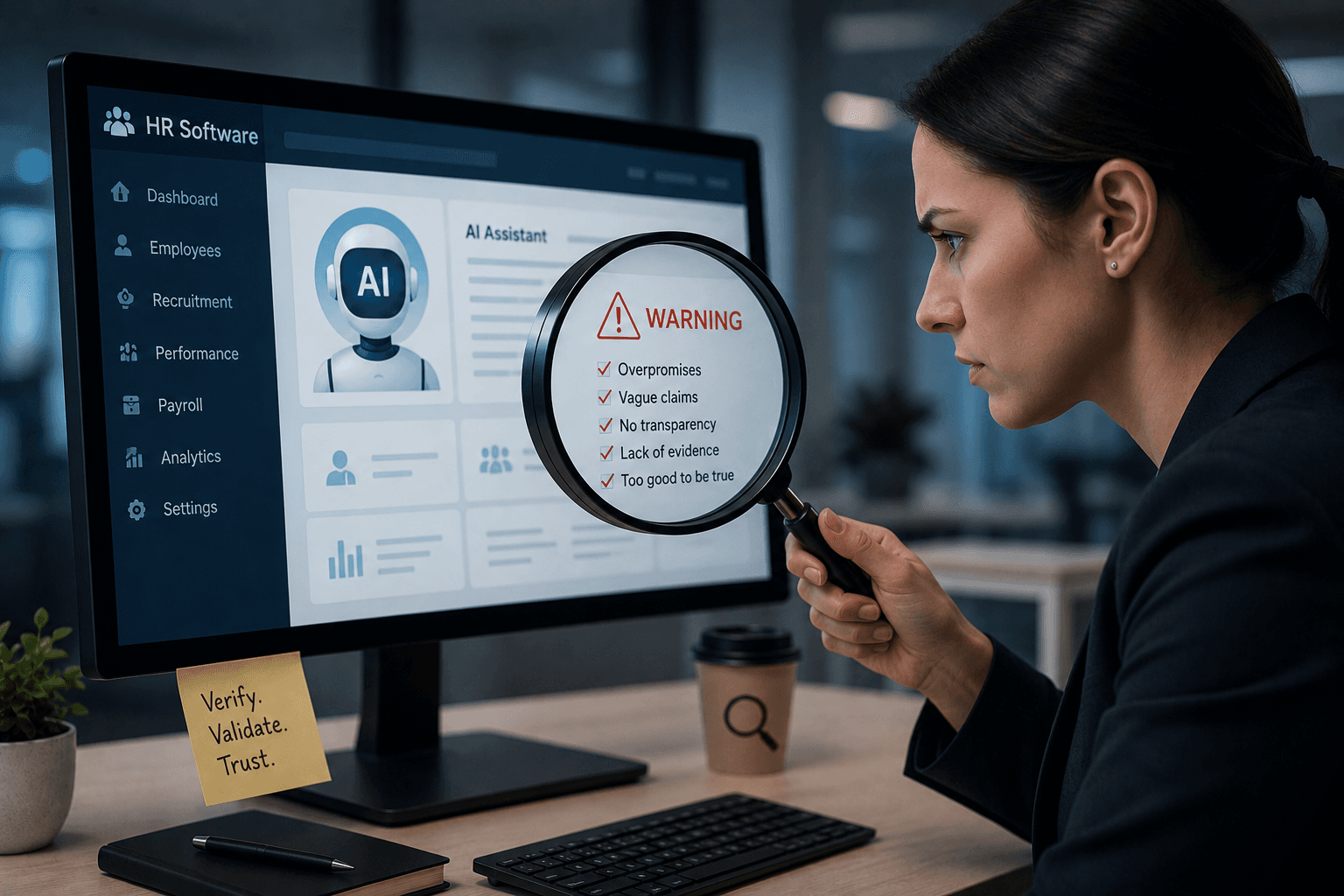
Spotting fake AI starts with knowing the red flags. The first is <span class="ht-strong-o">an inability to explain its own outputs</span>. A genuine attrition risk model can show you which factors — tenure, engagement score, compensation relative to market — drove a particular flag. A fake AI system produces a score with no rationale. When you press the vendor, you get vague references to "multiple data points" rather than a specific answer.
</p>
<p class="ht-p">
The second red flag is a <span class="ht-strong-o">chatbot that only handles a fixed script</span>. Real conversational AI, built on genuine LLM integration, understands context and adapts to unscripted follow-up questions. Fake AI chatbots match keywords to pre-written responses and fall apart the moment an employee asks something slightly off-script. The third sign is <span class="ht-strong-b">predictions that never change</span> — a genuine predictive model updates when an employee gets promoted, changes managers, or completes a development programme. If the risk scores stay flat regardless of what is actually happening in your workforce, the system is not predicting anything. And finally, <span class="ht-strong-o">a vendor who cannot tell you how their AI was trained</span> — what data, how it was validated, how bias was tested — is almost certainly not operating a genuine AI system.
</p>
<!-- Pull Quote 2 — dark blue background -->
<div class="ht-pullquote2">
<p>"A polished demo proves nothing about long-term accuracy. Ask for a reference customer who has used the AI features for more than twelve months."</p>
<span class="ht-attr">— Team peopleHum, peopleHum Blog</span>
</div>
<hr class="ht-divider">
<!-- Section Header 2 — teal bar -->
<h2 class="ht-h2"><span class="ht-h2-bar-t"></span>The Questions Every HR Buyer Should Ask</h2>
<p class="ht-p">
Before signing any contract for an HR platform claiming AI capability, HR leaders need to ask harder questions than vendors expect. Start with: <span class="ht-strong-o">What specifically does the AI optimise for?</span> A genuine system has a clearly defined objective — it predicts a specific outcome based on specific inputs. If the vendor cannot answer that question precisely, the AI is not doing what they claim. Then ask: <span class="ht-strong-b">How does the system handle data it has never seen before?</span> Real machine learning produces reasonable outputs on novel cases. Rule-based systems disguised as AI often produce unreliable results or simply break down.
</p>
<p class="ht-p">
Two more questions matter enormously. First, <span class="ht-strong-o">how often does the model update, and what triggers a revision?</span> A genuine learning system retrains continuously as new data flows through; a fixed-rule system does not change at all. Second — and perhaps most revealing — <span class="ht-strong-b">what happens when the AI is wrong?</span> Trustworthy vendors acknowledge error rates, explain how errors are identified, and describe the correction process. Vendors who claim their AI is always accurate, or who sidestep this question entirely, are not operating a genuine AI system. And always ask to speak with a reference customer who has used the AI features for more than twelve months — anyone can produce a polished demo.
</p>
<!-- Section Header 3 — teal bar -->
<h2 class="ht-h2"><span class="ht-h2-bar-t"></span>What Genuine AI in HR Actually Looks Like</h2>
<p class="ht-p">
Real AI in HR is structurally different from systems where AI has been added as a feature layer after the fact. A genuinely AI-native platform <span class="ht-strong-o">explains its reasoning</span> — when it flags an employee as a retention risk, it shows the specific signals driving that assessment. It <span class="ht-strong-b">updates in real time</span> through event-driven pipelines, so a new performance rating, a completed training module, or a change in team structure is reflected immediately in the AI's output. And it <span class="ht-strong-o">draws on connected data across the full employee lifecycle</span> — hiring AI that can see performance patterns from the current workforce, engagement AI that draws simultaneously on attendance, performance, and sentiment data — rather than operating in isolated modules that were never designed to share information.
</p>
<p class="ht-p">
The protection available to HR buyers is knowledge. Knowing what real AI looks like, knowing the questions that expose weak claims, and recognising vague answers as a warning sign rather than acceptable nuance — these are the tools that separate buyers who get genuine capability from those who pay for a polished interface. When a vendor gives you confident, specific, detailed answers to the hard questions, that is when you know you are talking to someone who actually built what they are selling.
</p>
</div>
<!-- KEY TAKEAWAYS -->
<div class="ht-takeaways">
<div class="ht-tk-header">
<span class="ht-tk-title">Key Takeaways</span>
<div class="ht-tk-line"></div>
</div>
<div class="ht-tk-row">
<div class="ht-tk-num" style="background:#F26522;">1</div>
<p class="ht-tk-text"><strong style="color:#F26522;">The market is flooded with mislabelled AI.</strong> Rule-based chatbots, keyword screeners, and static dashboards are routinely marketed as AI. HR buyers who cannot distinguish real from fake risk making consequential decisions based on outputs that are not intelligent at all.</p>
</div>
<div class="ht-tk-row">
<div class="ht-tk-num" style="background:#2E6DB4;">2</div>
<p class="ht-tk-text"><strong style="color:#2E6DB4;">Four red flags reliably expose fake AI.</strong> It cannot explain its outputs, chatbots collapse outside a fixed script, predictions stay static regardless of workforce changes, and vendors give vague or evasive answers when asked how the model was trained and validated.</p>
</div>
<div class="ht-tk-row">
<div class="ht-tk-num" style="background:#00B4C8;">3</div>
<p class="ht-tk-text"><strong style="color:#00B4C8;">Ask the hard questions before signing.</strong> What does the AI optimise for? How does it handle novel data? How often does the model update? What happens when it is wrong? Vendors who give confident, specific answers to all of these are worth trusting.</p>
</div>
<div class="ht-tk-row">
<div class="ht-tk-num" style="background:#F26522;">4</div>
<p class="ht-tk-text"><strong style="color:#F26522;">Demand long-term reference customers.</strong> A demo proves nothing about sustained accuracy or improvement over time. Any vendor serious about their AI claims can produce customers who have used those features for more than twelve months and seen results.</p>
</div>
<div class="ht-tk-row">
<div class="ht-tk-num" style="background:#1B2A4A;">5</div>
<p class="ht-tk-text"><strong style="color:#1B2A4A;">Real AI is structural, not cosmetic.</strong> Genuine AI in HR explains its reasoning, updates continuously as data changes, and connects information across the entire employee lifecycle. These are properties of how a system was built — they cannot be bolted on after the fact.</p>
</div>
</div>
<!-- FOOTER TAGS -->
<div class="ht-footer">
<div class="ht-tags">
<span class="ht-tag-label">Tags</span>
<span class="ht-tag ht-tag-o">AI in HR</span>
<span class="ht-tag ht-tag-b">HRMS Software</span>
<span class="ht-tag ht-tag-t">HR Technology</span>
<span class="ht-tag ht-tag-n">Predictive Analytics</span>
<span class="ht-tag ht-tag-o">HR Buying Guide</span>
<span class="ht-tag ht-tag-b">Machine Learning</span>
</div>
<div class="ht-bottom-bar">
<div class="ht-bb1"></div>
<div class="ht-bb2"></div>
<div class="ht-bb3"></div>
</div>
</div>
</div>
</body>
</html>