
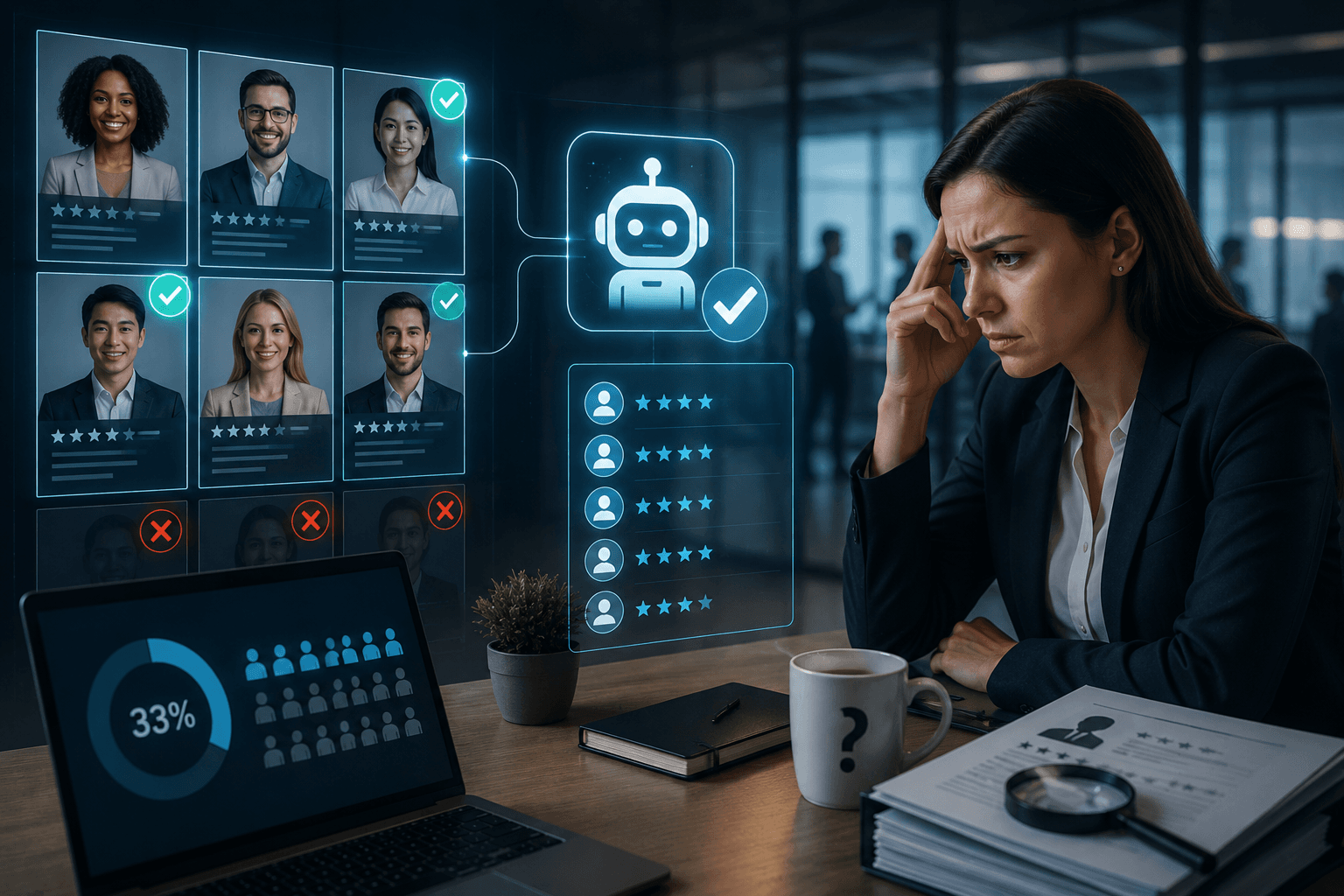
One in Three HR Teams Expect AI to Run Hiring by 2030. Here's Why That Is a Problem.
One in three HR teams now expect AI to run the majority of their hiring process by 2030. The efficiency case is real — faster screening, reduced time-to-hire, lower cost-per-application. But here is what those numbers do not capture.
Consider a logistics company that deployed an AI hiring system to screen CVs, score candidates, and shortlist applications. Within eight months, it had filled thirty-two roles faster than any previous hiring cycle. The process felt like a success. Two years later, the HR lead noticed that every team built through the AI system was remarkably similar — same educational backgrounds, same career progression patterns, same communication styles. Nobody had intended this. Nobody had reviewed the system closely enough to catch it. And by the time it was visible, two years of compounding hiring decisions had already been made.
This is a story about what happens when HR hands hiring to AI without maintaining the oversight, accountability, and human judgment that consequential decisions require.
"The organisation that cannot explain its hiring decisions because an AI made them is in a significantly worse legal position than the organisation whose human decisions were made badly."
— AI Hiring Governance AnalysisWhat AI Can Genuinely Do Well in Hiring
AI has made specific parts of the hiring process faster, more consistent, and less dependent on individual recruiter bandwidth — and those improvements are worth building on. High-volume initial screening is where AI performs most reliably: it does not get tired, does not consciously apply different standards, and can process hundreds of applications with a consistency no human reviewer can sustain. Scheduling and logistics — coordinating interviews, sending confirmations, tracking application status — is the category of hiring work most suitable for full AI automation.
Structured AI-powered assessment tools can apply the same evaluation criteria to every candidate, removing the variability that comes from different interviewers applying different standards to the same question. And over time, AI can surface patterns in hiring data that improve future decisions: which sourcing channels produce the best long-term hires, which assessment scores correlate with performance, and where candidate drop-off is highest. This intelligence makes the overall system better.
"The efficiency gain of AI screening is partly produced by the systematic exclusion of the candidates who would most challenge the model's assumptions — the very candidates a skills-based talent strategy requires HR to reach."
— AI Hiring Bias AnalysisWhy Handing Hiring to AI Is a Fundamentally Different Proposition
There is a critical distinction between AI that supports hiring decisions and AI that runs them. In a support model, the human still decides — accountability for the outcome sits with a person who can explain their reasoning. In an autonomous model, the AI determines who progresses, scores candidates, sequences the shortlist, and may conduct initial interviews. The human reviews the output, but the meaningful choices have already been made by the system.
This second model has specific and serious problems. Legal accountability for hiring decisions cannot be delegated to an algorithm. In most jurisdictions, employment decisions are subject to anti-discrimination law. When a candidate is rejected, the organisation must demonstrate the rejection was based on legitimate, non-discriminatory criteria. If AI made that decision through a system the organisation cannot fully explain, the legal liability does not transfer to the algorithm — it remains with the organisation, in a considerably weaker defensive position.
AI hiring systems also optimise relentlessly for the patterns in their training data. The logistics company's AI did not set out to reproduce historical hiring patterns — it did so because that is what optimisation against past decisions produces. If those decisions reflected bias, that bias is reproduced at scale and speed. If the organisation's talent needs have evolved, the AI continues optimising for the profile of the person who succeeded in the role before — not the one who will succeed in it going forward. Candidates with non-linear career paths, career gaps, and unconventional backgrounds — the very candidates a skills-based talent strategy specifically requires — are the ones AI systems most consistently screen out.
The Accountability Gap AI Hiring Creates
When a human recruiter makes a poor hiring decision, there is accountability. The decision can be examined, the recruiter developed or held responsible. When an AI system makes a poor hiring decision, accountability becomes diffuse. Was the problem the training data? The model design? The configuration choices made at implementation? The absence of human review? Each party can point to the others — and in that diffusion, the wrongly rejected candidate and the organisation that missed the right hire pay the price while responsibility remains genuinely unclear.
This accountability gap is a structural feature of AI decision-making that organisations have not yet developed adequate governance frameworks to address. The more autonomy AI is given in hiring, the wider this gap becomes. HR's responsibility is to ensure hiring decisions can be explained, defended, and learned from — and that responsibility requires human accountability at every stage where a consequential decision is made.
What HR Should Build Before 2030
The right response to the 2030 expectation is not to slow AI adoption in hiring. It is to change what HR is building toward. The organisations constructing the most effective hiring systems are not moving toward less human involvement — they are moving toward better-placed human involvement. Humans make the decisions that require genuine judgment, at the specific stages where that judgment is differentiating. AI handles everything else.
This requires five concrete commitments. First, build explainability — require AI vendors to demonstrate that hiring recommendations can be explained in terms a human can understand and defend. If the vendor cannot explain how the system reaches its conclusions, the system cannot be used for consequential decisions. Second, audit AI tools for bias on an ongoing basis — bias accumulates over time and is not always visible at implementation; regular examination of hiring outcomes across demographic groups is essential. Third, map human decision points explicitly before deploying any tool, documenting which stages involve consequential decisions and whether each will be made by AI, by a human informed by AI, or by a human independently.
Fourth, train hiring managers to interrogate AI recommendations rather than ratify them — the hiring manager who treats an AI shortlist as a final answer is delegating judgment while retaining only the appearance of human involvement. Fifth, and most critically, measure hiring quality rather than hiring speed. Time-to-fill and cost-per-hire do not reveal whether the right people were hired. New hire performance at six and twelve months, retention rates, manager satisfaction, and diversity outcomes across sourcing channels are the metrics that expose what efficiency numbers conceal — and the only honest basis for evaluating whether AI hiring tools are producing good outcomes.
AI Has a Real but Bounded Role. High-volume screening, scheduling, consistent assessment, and hiring analytics are areas where AI adds genuine value — but supporting human decisions is fundamentally different from replacing them.
Legal Liability Stays with the Organisation. Anti-discrimination law does not transfer accountability to an algorithm. Organisations that cannot explain AI-made hiring decisions are in a worse legal position than those whose human decisions were imperfect.
Bias Compounds Silently Over Time. AI systems optimise for historical patterns — including historical biases. Without ongoing audits, two years of compounding decisions can reshape an organisation's workforce in ways no one intended or noticed.
Better-Placed Human Involvement Is the Goal. The direction of travel is not more AI autonomy — it is humans making consequential decisions with better AI support, at the specific points where judgment genuinely matters.
Measure Outcomes, Not Just Speed. Time-to-fill and cost-per-hire conceal as much as they reveal. Hiring quality metrics — performance, retention, diversity — are the only honest basis for evaluating whether AI hiring tools are working.