
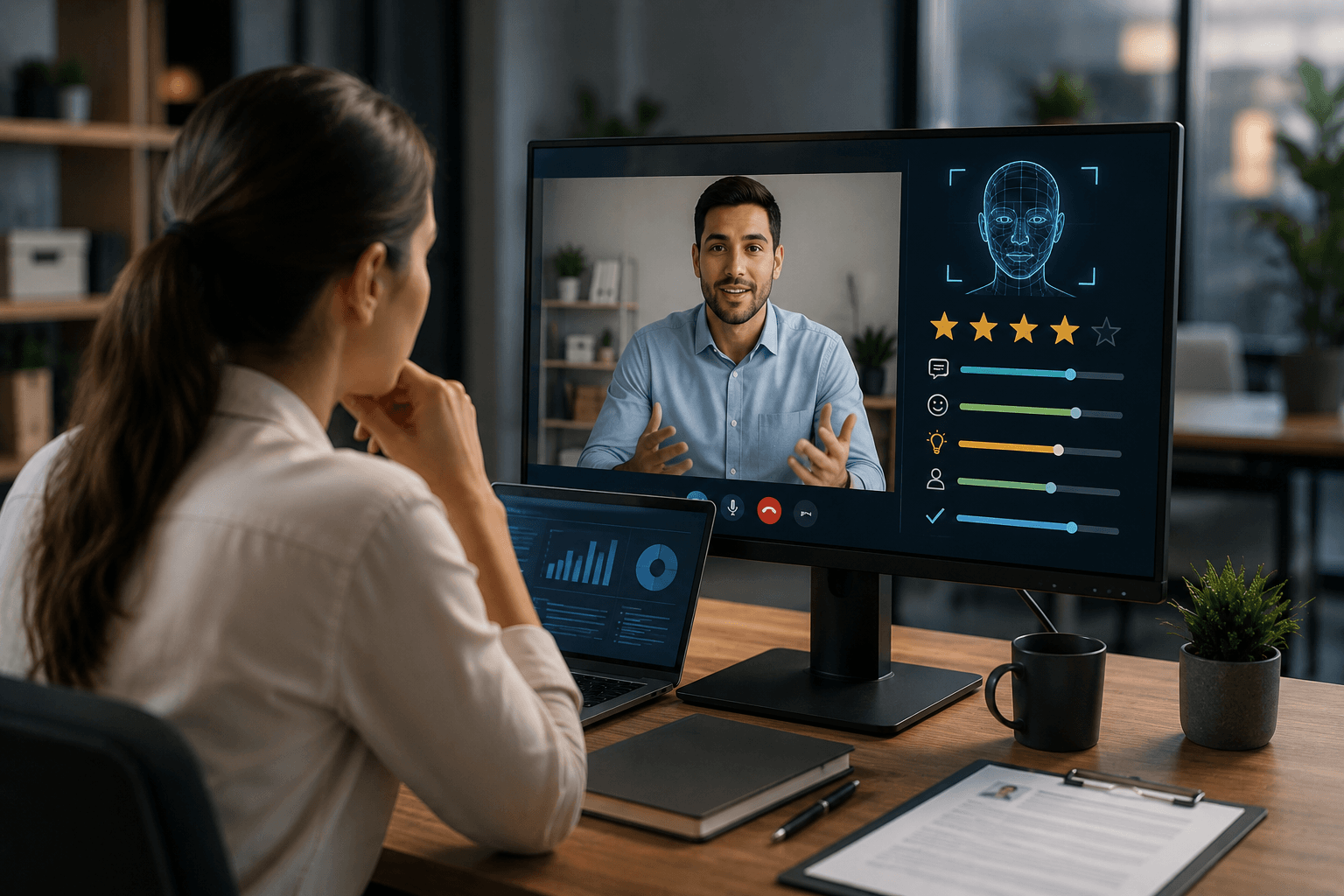
VidCruiter Launches AI Interview Scoring — Transparent, Auditable, Biometric-Free AI That Eliminates the Speed-vs-Quality Trade-Off in High-Volume Hiring
VidCruiter (Montreal; a leading video interviewing platform; trusted by more than 125,000 hiring professionals worldwide; Chief AI Officer Andrew Buzzell), has announced the launch of AI Interview Scoring — a category-defining capability that fundamentally changes how organisations evaluate candidates at scale. The release is described as one of the most significant additions to the VidCruiter platform to date, delivering a consistent, explainable, and fully auditable way to score pre-recorded video interview responses with AI. Available today as part of the VidCruiter platform, AI Interview Scoring applies the same client-approved rubric to every candidate response for a given question — removing reviewer variability while preserving complete transparency into how each score was reached. The system is built explicitly for validation testing and bias auditing — and deliberately excludes biometric signals.
"Trustworthy AI in hiring isn't a marketing claim. It's an engineering discipline. We built AI Interview Scoring around a clear set of principles: client-approved rubrics, evaluations grounded strictly in what candidates actually say, and a complete rationale behind every score. We deliberately exclude biometric signals because fairness and scientific validity demand it. The result is a system that can withstand the validation testing and bias auditing required by modern hiring and regulation. This is what enterprise-grade AI in talent acquisition should look like."
— Andrew Buzzell, Chief AI Officer, VidCruiterHow AI Interview Scoring Works — Rubric-Grounded, Content-Only, Fully Explainable
AI Interview Scoring is built around four design principles that distinguish it from other AI hiring tools. First, client-approved rubrics: every scoring criterion is defined and approved by the hiring organisation before the AI applies it — ensuring that the AI is executing the employer's evaluation framework, not imposing an opaque model's own criteria. Second, content-only evaluation: the system evaluates strictly what candidates actually say — their verbal responses — and explicitly excludes biometric signals such as tone of voice, facial expressions, eye contact, and body language. This is a deliberate fairness and scientific validity decision: biometric signals are not validated predictors of job performance, and their use in AI hiring tools is increasingly scrutinised by regulators and civil rights organisations. Third, complete rationale behind every score: hiring teams and compliance partners can readily evaluate the AI's reasoning and the criteria behind every candidate score — making each decision transparent and defensible in any review or audit. Fourth, validation testing and bias auditing readiness: the system is built to withstand the testing that modern hiring regulations and enterprise compliance requirements demand.
"For years, high-volume hiring has forced recruiters into an unwelcome compromise: move quickly and accept inconsistency between reviewers, or evaluate rigorously and grind the process to a halt. AI Interview Scoring eliminates that trade-off — applying the same rubric to every candidate, at scale, with complete transparency into how each score was reached."
— VidCruiter, AI Interview Scoring Launch StatementThe High-Volume Hiring Problem AI Interview Scoring Solves
The structural problem AI Interview Scoring addresses is well established in talent acquisition: at scale, human reviewers introduce inconsistency — different reviewers apply the same rubric differently, score candidates against different mental benchmarks, and make different decisions for candidates who gave equivalent responses. The only alternatives have been to slow the process to ensure rigour, or to accept inconsistency in exchange for speed. AI Interview Scoring eliminates the trade-off entirely — the same rubric, applied the same way, to every candidate, every time. VidCruiter's broader platform context reinforces the strategic positioning: the platform is already known for its structured interviewing philosophy — digital rating guides that force objectivity, sequential video interview workflows, and WCAG accessibility compliance that make it a preferred choice for government and public sector hiring. AI Interview Scoring extends this philosophy into automated scoring — bringing the same structured, auditable approach to the AI layer that VidCruiter has always applied to the human evaluation layer.
VidCruiter launches AI Interview Scoring. Montreal; Chief AI Officer Andrew Buzzell; leading video interviewing platform; 125,000+ hiring professionals worldwide. Announced 13 May 2026. One of the most significant additions to the VidCruiter platform to date. Available today as part of the VidCruiter platform. Category-defining capability that fundamentally changes how organisations evaluate candidates at scale. vidcruiter.com.
Four design principles — what makes VidCruiter's AI different. (1) Client-approved rubrics — every scoring criterion defined and approved by the hiring organisation; AI executes the employer's evaluation framework, not an opaque model's criteria. (2) Content-only evaluation — evaluates strictly what candidates say; explicitly excludes biometric signals (tone of voice, facial expressions, eye contact, body language) on the grounds of fairness and scientific validity. (3) Complete rationale behind every score — hiring teams and compliance partners can evaluate the AI's reasoning and criteria behind every decision; transparent and defensible in any review or audit. (4) Validation testing and bias auditing readiness — built to withstand the testing that modern hiring regulations and enterprise compliance requirements demand.
The problem it solves — the speed-vs-quality trade-off in high-volume hiring. At scale, human reviewers introduce inconsistency — different reviewers apply the same rubric differently, score against different mental benchmarks, and make different decisions for equivalent candidate responses. The two alternatives: move quickly and accept inconsistency, or evaluate rigorously and grind the process to a halt. AI Interview Scoring eliminates this trade-off: same rubric, applied the same way, to every candidate, every time. Removes reviewer variability while preserving complete transparency into how each score was reached.
VidCruiter platform context — structured interviewing at enterprise scale. VidCruiter is known as the "Structured Interviewing Platform" — focusing on rigour over speed. Digital Rating Guides force objectivity by having interviewers click structured rating buttons (1–5) directly during video review. Sequential Video Interview workflows (Screen → Test → Panel) run automatically without recruiter intervention. WCAG accessibility compliance (Accessibility-First design in 2026) — preferred choice for government and public sector hiring. Live and pre-recorded video interviewing. Interview scheduling, skills testing, automated reference checks. AI Interview Scoring extends the structured philosophy to the AI scoring layer.
Strategic significance — the biometric exclusion as the defining differentiator. Andrew Buzzell's deliberate exclusion of biometric signals is the most important design decision in AI Interview Scoring — and the one that most distinguishes it from competitor AI hiring tools that analyse facial expressions, tone, and body language. The scientific consensus is clear: biometric signals in video interviews are not validated predictors of job performance, and their use introduces bias risk that disproportionately affects candidates from different cultural backgrounds, neurodivergent candidates, and candidates with disabilities. Regulators in New York City, Illinois, and the EU AI Act are increasingly targeting biometric AI in hiring. VidCruiter's content-only, rubric-grounded approach is not just ethically sound — it is the architecture most likely to survive regulatory scrutiny. For enterprise HR leaders and legal teams evaluating AI hiring tools in 2026, this is the compliance-first differentiator that matters most.