
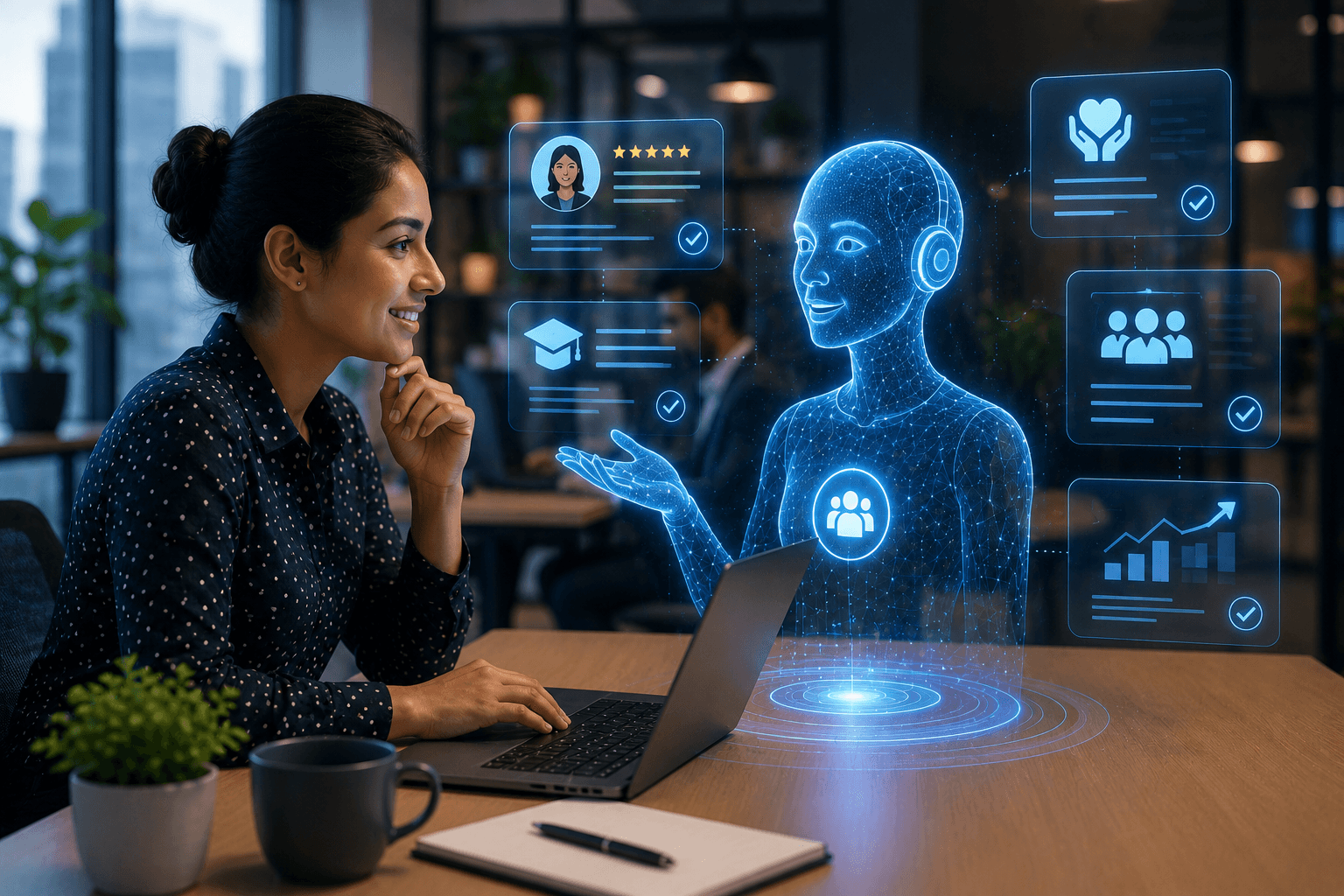
AI that makes HR feel personal
Employees rarely quit a job description — they quit the feeling of being invisible. Most HR teams already sense this truth about company culture: generic policies neither build culture nor sustain it. Yet most HR systems still treat every employee identically — the same emails, the same benefits pitch, the same feedback form. And employees can tell the difference immediately.
"People don't leave jobs. They leave to escape the feeling of being unseen."
— Team peopleHumThe problem with one-size-fits-all HR
Generic policies look efficient on paper: one email reaches everyone, one benefits package covers every role. But picture a new parent receiving the exact same wellness email as a colleague with zero dependents. That mismatch accumulates quietly. Employees rarely complain about generic treatment directly — they simply disengage, skim past company emails, and stop expecting HR to understand their situation. Over time, that erosion undermines trust in the system itself.
For HR teams building company culture, this is a real problem. Culture is not built through mass communication — it is built through moments where employees feel genuinely understood. Generic systems simply cannot manufacture those moments.
Why personalisation needs AI
Personalising HR at scale has always been the hard part. A 50-person company can hand-tailor policies for each employee; a 500-person company cannot — there is simply not enough time or HR capacity to customise every message, policy nudge, and check-in for each individual. That is why most companies default to generic systems, forcing a choice between "personal but unsustainable" and "generic but manageable." Neither serves culture well — and this is precisely the gap AI is positioned to close.
"Culture is not about grand gestures. It is about small, consistent signals that say: we see you."
— Team peopleHumHow AI makes every employee experience personal
AI tools can draw on individual context — role, tenure, past feedback, and engagement patterns — to shape communication automatically. Take onboarding: rather than one welcome email for everyone, AI tailors content by role and location, so a new sales hire sees sales-tool onboarding while a finance hire sees an entirely different set of priorities. The same logic runs through the ongoing employee experience: AI can flag when someone's engagement dips against their own baseline, suggest learning paths matched to actual skill gaps, and time check-ins around individual milestones. This is how AI strengthens culture rather than replacing it — by making "we see you" signals possible at a scale no HR team could manage manually.
Building company culture with AI
Without AI, personal attention often depends on which manager an employee happens to get. A great manager creates a personal experience; an overwhelmed one — however well-intentioned — defaults to generic treatment purely from time constraints. The result is cultural inconsistency: some employees feel valued while others do not, based purely on circumstance. AI reduces that inconsistency by ensuring every employee receives onboarding, communication, and training designed for their role and skills — regardless of manager, team, or office. It does not remove the need for managers; it removes the organisation's dependency on individual managers to make HR feel personal. That shift is what makes culture truly scalable.
What this looks like in practice
Platforms like peopleHum let HR teams use AI to personalise onboarding journeys, flag disengagement early, and tailor experience touchpoints from real individual data instead of company-wide blasts — so no employee experiences HR as a faceless system, no matter how large the organisation grows. The shift also gives HR something valuable: visibility. Instead of guessing whether policies are landing, teams see real-time engagement data showing where personalisation is working, where gaps remain, and how those gaps affect culture.
Personal at scale is no longer a trade-off
For years, HR accepted a hard trade-off: personal attention or operational scale, rarely both. AI removes it — letting organisations treat every employee as an individual without an impossible manual workload. The organisations that get this right will be the ones using AI to reinforce what company culture was always meant to be: employees feeling genuinely seen.
Generic HR quietly erodes culture. Employees rarely complain about one-size-fits-all treatment — they disengage, stop reading communications closely, and stop expecting HR to understand them. That erosion compounds over time.
Culture lives in small, consistent signals. A single mass email cannot make anyone feel understood. The moments that tell an employee "we see you" are what company culture is actually made of.
AI closes the personalisation-at-scale gap. A 50-person company can personalise manually; a 500-person company cannot. AI ends the forced choice between "personal but unsustainable" and "generic but manageable."
Consistency no longer depends on luck of the manager. AI ensures every employee gets role-relevant onboarding, communication, and learning — regardless of which manager, team, or office they land in.
Real visibility replaces guesswork. AI surfaces individual engagement patterns in real time, showing HR exactly where personalisation is working and where gaps remain — before disengagement becomes attrition.