
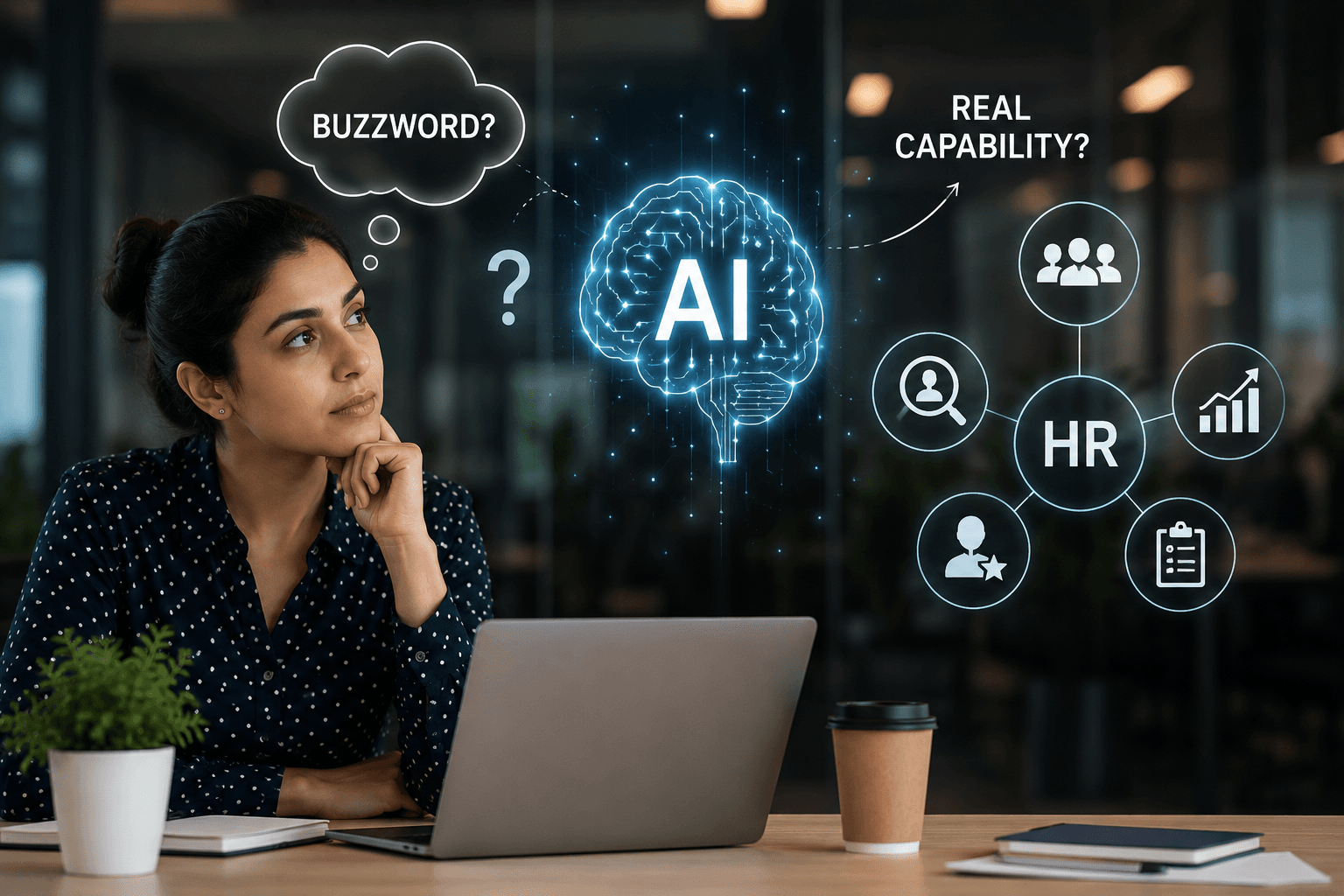
Artificial Intelligence: A Buzzword or Real Capability for HR?
Many HR leaders are still wrestling with a fundamental question: is Artificial Intelligence actually transforming HR, or is it just the latest shiny object? Many HR professionals now rank AI and workplace digitisation among their top concerns — above governance, engagement, and even talent. And yet, plenty privately admit they're not sure AI is delivering anything real.
The scepticism has not disappeared. It comes from genuine experience, genuine frustration, and genuine unanswered questions. This piece takes the most common myths HR professionals hold about Artificial Intelligence and separates fair criticisms from outdated assumptions.
"The real premium going forward will be on discernment — knowing when not to use AI — not on Artificial Intelligence fluency alone."
— Rita Ramakrishnan, Executive CoachMyth 1: AI Is Just a Trend Leadership Is Chasing
Many HR teams have watched leadership chase technology trends before — cloud migration, big data, digital transformation — only to see enthusiasm fade within a year. According to SHRM's State of AI in HR 2026 Report, a notable share of HR professionals whose organisations have not deployed AI describe feeling pressure to adopt it anyway, out of fear of falling behind rather than a clear operational need. That is a legitimate concern.
So the myth contains a partial truth. AI adopted without a clear purpose often looks like trend-chasing. But that is a failure of strategy — not evidence that the underlying capability is hype. Organisations using AI to solve specific, well-defined HR problems, like reducing time-to-hire or identifying early attrition risk, are seeing results that have nothing to do with trend-chasing.
Myth 2: AI Removes the Human Element HR Is Supposed to Protect
HR exists to protect people. Many HR professionals worry, reasonably, that introducing AI into sensitive moments — performance conversations, wellbeing support, redundancy decisions — replaces the human judgment those moments require. A 2026 scenario illustrates the real stakes: an employee confides in a company's AI coaching tool for six weeks about feeling isolated and questioning whether she belongs. The AI offers supportive messages but never escalates to a human — and the employee eventually resigns, alleging the company knew she was struggling and did nothing.
The lesson from that scenario is that AI must be designed with clear boundaries and mandatory escalation paths to humans when certain signals appear. Artificial Intelligence does not inherently remove the human element. Poorly governed AI, deployed without clear limits, can.
"90% of executives believe employees feel safe reporting unethical or dangerous AI behaviour — but the research suggests otherwise."
— Writer's 2026 AI Governance SurveyMyth 3: AI Only Works for Large Companies with Big Budgets
Many HR leaders at small and mid-sized organisations assume that AI in HR is reserved for enterprises with dedicated data science teams and large technology budgets. Today, AI capabilities that once required custom-built infrastructure are increasingly available through HR platforms designed for organisations of all sizes. The barrier to using AI effectively in HR is shifting away from budget and toward strategy and governance — regardless of company size.
Myth 4: Employees Will Speak Up About AI Problems Without Being Prompted
While a large majority of executives assume employees feel safe reporting unethical or dangerous AI behaviour, research highlights significant gaps between what leadership assumes and what is actually happening on the ground. HR professionals who worry that problems with AI tools will go unreported until a crisis emerges are identifying a real organisational weakness. The solution is not to avoid AI, but to build explicit, low-friction reporting channels and a culture where raising concerns is treated as valuable.
Myth 5: AI Scepticism Is the Same Everywhere
According to a Salesforce survey, 53% of workers in the US, UK, and France identify as AI sceptics, compared with just 15% in Saudi Arabia and 26% in Mexico. Scepticism toward AI is not a fixed, universal employee trait — it varies significantly by geography, culture, and prior experience with technology adoption. HR teams operating across multiple regions need to recognise that a one-size-fits-all approach to AI communication and rollout will land very differently depending on where their workforce sits.
What Separates Real Capability from Buzzword Use
All the myths above share a pattern. Each contains a grain of truth — usually rooted in poor implementation, insufficient governance, or a genuine organisational gap. None of them proves that Artificial Intelligence itself lacks real capability in HR. The distinction between buzzword use and real capability comes down to three things: specificity of purpose (AI matched to a clearly defined problem), manager and employee readiness (people trained to use the tools well), and strong governance with clear boundaries and mandatory human escalation paths.
AI in HR is not a buzzword. The capability is real, documented, and increasingly accessible to organisations of every size. Fix the readiness gap, build the governance, and match the technology to a specific problem. Do that, and Artificial Intelligence stops being a buzzword and becomes exactly what it claims to be: a genuine capability that strengthens, rather than replaces, the work HR exists to do.
Purpose Over FOMO. AI adopted without a clear operational need looks like trend-chasing because it is. Organisations seeing real results use AI to solve specific, well-defined problems — not because competitors are doing it.
Governance Is the Safeguard. AI doesn't inherently remove the human element — poorly governed AI does. Clear escalation paths to human HR professionals are non-negotiable, especially in sensitive employee interactions.
Size Is No Longer a Barrier. The assumption that AI in HR is reserved for large enterprises is increasingly outdated. The real barrier has shifted from budget to strategy and governance, regardless of company size.
Build Reporting Channels Proactively. Most executives overestimate how safe employees feel raising AI concerns. Organisations must create explicit, low-friction reporting mechanisms before problems escalate into crises.
Scepticism Varies by Region. AI scepticism is not universal — it ranges from 53% in some Western markets to as low as 15% in others. Global HR teams need region-specific communication and rollout strategies, not a one-size-fits-all approach.