
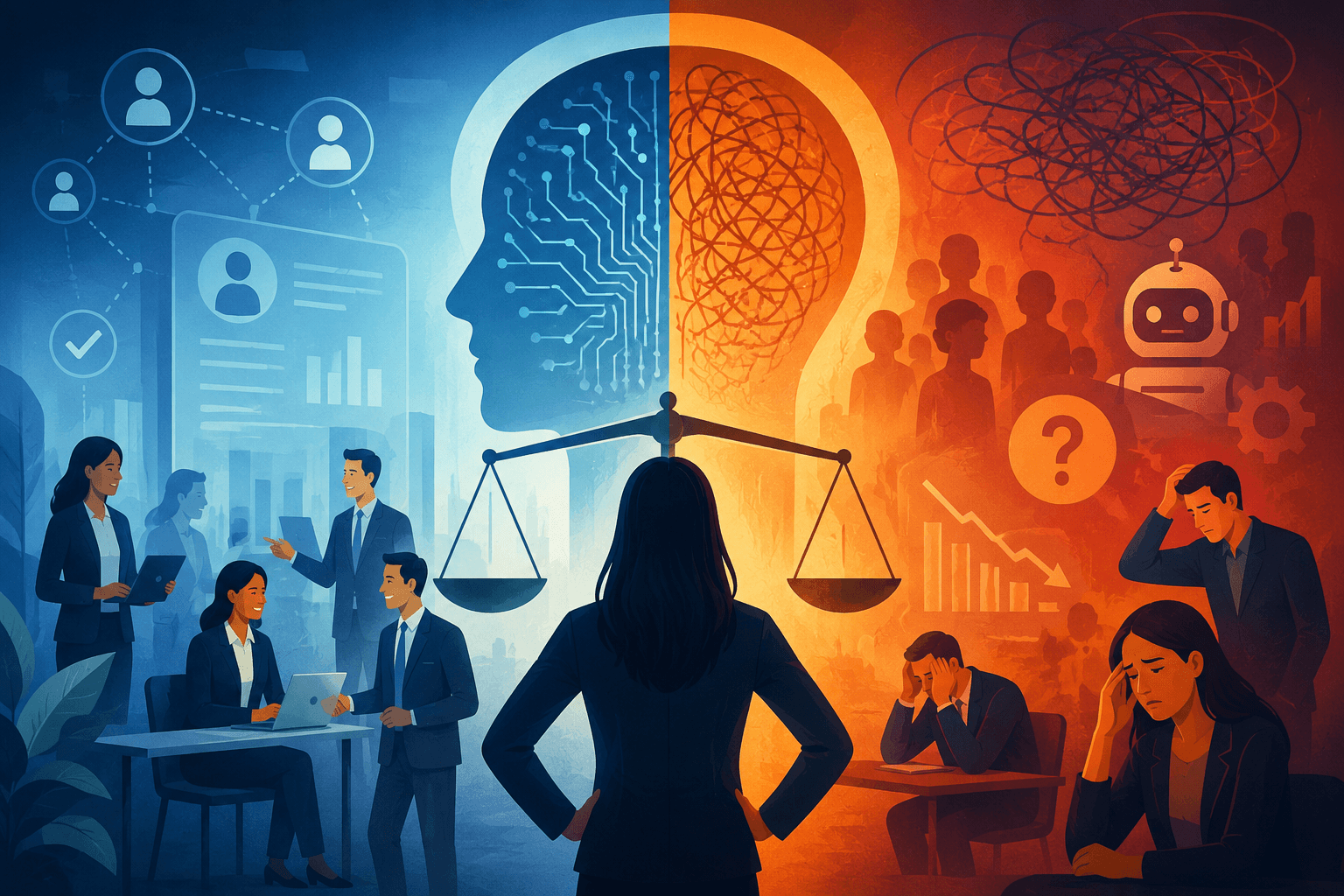
AI driving HR. Future or disaster?
Every few years, a technology arrives promising to transform HR. Most fade into oblivion, but AI feels different, and the debate reflects that. Some CHROs see AI as the biggest opportunity HR has had in decades. Others worry it will hollow out company culture and replace genuine human judgment with automated efficiency. Both arguments have their merits.
The honest answer depends entirely on how AI gets implemented. Understanding both the real risks and the real potential is the only way CHROs can make this call with confidence.
The case for AI as HR's future
HR teams have spent years drowning in repetitive administrative work — processing paperwork, answering the same policy questions, and manually tracking onboarding checklists. AI tools can take over most of these, freeing HR professionals for higher-value work that requires human judgment.
AI tools also flag early behavioural signs. Traditional HR processes only flagged disengagement after the employee had already resigned. AI can flag the same while there is still time to act.
"At its core, AI is a multiplier. It amplifies whatever HR strategy already exists."
— AI driving HR. Future or disaster?, peopleHumThe case for AI as a company culture disaster
The most common fear for CHROs is that AI, when deployed carelessly, strips the humanity out of company culture. An organisation that lets chatbots handle emotionally sensitive conversations, or that reduces employee experience to dashboards and automated nudges, risks building a workplace that feels efficient but hollow.
There's also a risk of over-reliance. If HR teams start trusting AI-generated insights without applying human judgment, they can misread situations. An engagement dip flagged by AI might reflect a temporary personal circumstance rather than genuine dissatisfaction. Company culture built primarily around automation risks feeling impersonal at exactly the moments it matters most. Employees going through genuine distress don't want a well-worded chatbot response — they want a person who listens.
Where the real risk actually lives
The disaster scenario is AI being deployed without clear boundaries, transparency, and a plan for keeping humans central to any HR decisions and conversations.
Consider two organisations adopting the identical AI tool. One uses it to automate routine questions and free up manager time for genuine check-ins. The other uses it to reduce headcount and let automated messages substitute for real conversations. Same technology, completely different outcome for company culture. The tool is not the deciding factor — it's the intent behind its deployment.
"Applied to a genuinely people-focused culture, AI strengthens it. Applied to a culture that already treated people as line items, it accelerates the dehumanisation."
— AI driving HR. Future or disaster?, peopleHumWhat separates good AI adoption from bad
A few patterns consistently separate organisations that get this right from those that don't. First, successful adopters are explicit about where AI's role ends and human judgment begins. Routine, transactional interactions go to AI; emotionally significant conversations stay firmly with people, without exception.
Second, they treat AI output as a starting point. A flagged disengagement signal prompts a real conversation, not an automated response. Third, they measure the right things — not just tickets resolved and time saved, but whether employees actually feel more supported. If efficiency metrics improve while employee trust declines, that's the disaster scenario playing out in real time, even if the dashboard looks impressive. Finally, they're transparent: employees should always know whether they're talking to an AI system or a person, and should have an easy path to reach a human.
Company culture as the deciding factor
This is ultimately the crux of the entire debate. AI doesn't determine whether the outcome is future or disaster — company culture does. An organisation with a strong, genuinely people-first culture will use AI to reinforce that culture. An organisation without that foundation will use the same technology to paper over problems that were already there, making them harder to see, not easier to fix.
The real work for CHROs isn't primarily a technology decision — it's a culture decision that happens to involve technology. Before rolling out any AI tool, the more important question is whether the underlying company culture actually values the human judgment and empathy that AI is meant to free up time for. If that foundation isn't solid, no amount of sophisticated AI will fix it.
Neither future nor disaster
The framing in the title — future or disaster — assumes AI's impact on HR is predetermined. It isn't. The technology is neutral. What determines the outcome is entirely within HR's control: how deliberately AI gets deployed, where the boundaries are drawn, and whether the time it saves actually gets reinvested into genuine human connection.
For CHROs weighing this decision, the useful question isn't whether to adopt AI — adoption is happening across the industry regardless. The useful question is whether your organisation's culture is strong enough, and clear-eyed enough, to use AI as a multiplier for good practices rather than a mask for weak ones. Get that right, and the future scenario becomes far more likely than the disaster one.
AI is a multiplier. Applied to a people-first culture it strengthens it; applied to a culture that treats people as line items, it accelerates dehumanisation. The technology is the same — the intent behind deployment is what differs.
The disaster isn't AI itself. It's AI deployed without clear boundaries, transparency, or a plan for keeping humans central to decisions that affect people's working lives.
Four patterns separate good adoption from bad. Explicit human/AI boundaries; AI output as a prompt for real conversations; measuring whether employees feel supported; and full transparency about when people interact with AI versus a person.
Emotionally sensitive conversations stay with people. Employees in distress don't want a well-worded automated response — they want someone who listens. Over-reliance on AI signals without human context damages trust.
It's a culture decision, not a tech one. If the underlying culture doesn't genuinely value human judgment and empathy, AI won't fix it — it will make the gaps more visible instead.