
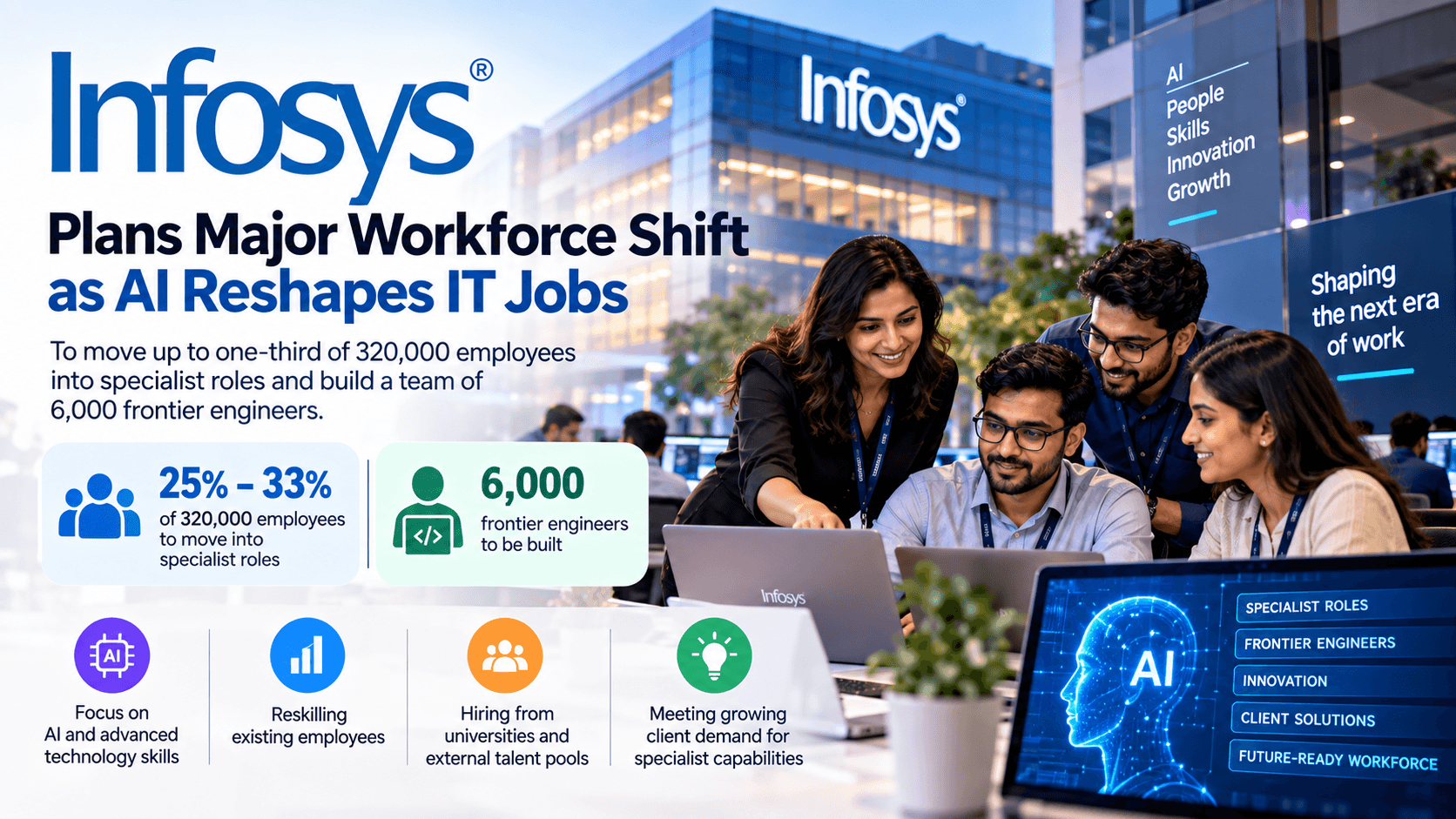
Infosys plans a major workforce transformation, moving between 25% and 33% of its more than 320,000 employees into specialist roles while building a team of around 6,000 frontier engineers.
The strategy reflects the growing demand for advanced AI, digital transformation and specialised technology skills across the global IT services industry.
Up to One-Third of Workforce to Move Into Specialist Roles
According to people who attended a recent Infosys event, the company plans to transition roughly one-quarter to one-third of its workforce into specialist positions. Based on a workforce of more than 320,000, that represents potentially 80,000 to more than 106,000 employees.
The shift is aimed at aligning employee capabilities with changing client requirements as AI increasingly becomes part of software development, consulting and enterprise technology services.
6,000 Frontier Engineers Planned
Alongside the internal reskilling effort, Infosys plans to build a team of approximately 6,000 frontier engineers, also referred to as Forward Deployed Engineers or FDEs.
These engineers are expected to combine software engineering, AI, product and consulting capabilities while working closely with clients to develop and deploy technology solutions.
Infosys CEO Salil Parekh previously said the company intends to develop the talent through a combination of internal training, recruitment from universities and external hiring rather than recruiting all 6,000 engineers from the market.
Competition for AI Talent
Infosys is also competing with AI companies and research labs for highly specialised talent. The company has been hiring from leading Indian institutions as well as US campuses as demand for advanced AI skills increases.
The competition highlights a broader change in the IT services market, where traditional technology delivery skills are increasingly being supplemented by expertise in AI engineering, data, cloud, automation and advanced software development.
AI Is Changing the IT Services Workforce
The planned workforce transition comes as Indian IT companies rethink how teams are structured and how technology services are delivered.
Forward-deployed engineers, for example, work more directly with customers to identify problems, develop solutions and take responsibility for outcomes rather than simply executing predefined specifications.
For Infosys, the specialist-role strategy could allow a larger portion of its workforce to participate in higher-value technology projects while giving employees pathways to develop capabilities aligned with emerging demand.
Focus on Reskilling and Internal Talent
Infosys' approach also places emphasis on developing existing employees rather than relying entirely on external recruitment.
Parekh said the company already has employees performing work at the frontier-engineer level and is bringing those capabilities together through a structured programme. Training and college recruitment will form additional parts of the talent pipeline.
The strategy comes as the IT sector faces a changing skills landscape, with AI automating some traditional tasks while increasing demand for engineers capable of integrating AI into complex business environments.
What the Shift Means for IT Jobs
Infosys' plans illustrate how AI is changing the composition of large technology workforces. Instead of focusing only on headcount expansion, IT services companies are increasingly looking at skill mix, specialist capabilities and the ability to deliver AI-enabled solutions.
For employees, this could mean greater emphasis on continuous learning in areas such as AI engineering, data, cloud, cybersecurity, software architecture and business-domain expertise.
Infosys' planned transition therefore represents not simply a workforce expansion or reduction, but a broader effort to reshape its talent base around the skills expected to be in demand as enterprise AI adoption accelerates.